fy***@gmail.com
An excellent analysis that lets me objectively examine my strengths and weaknesses and build a long-term plan.
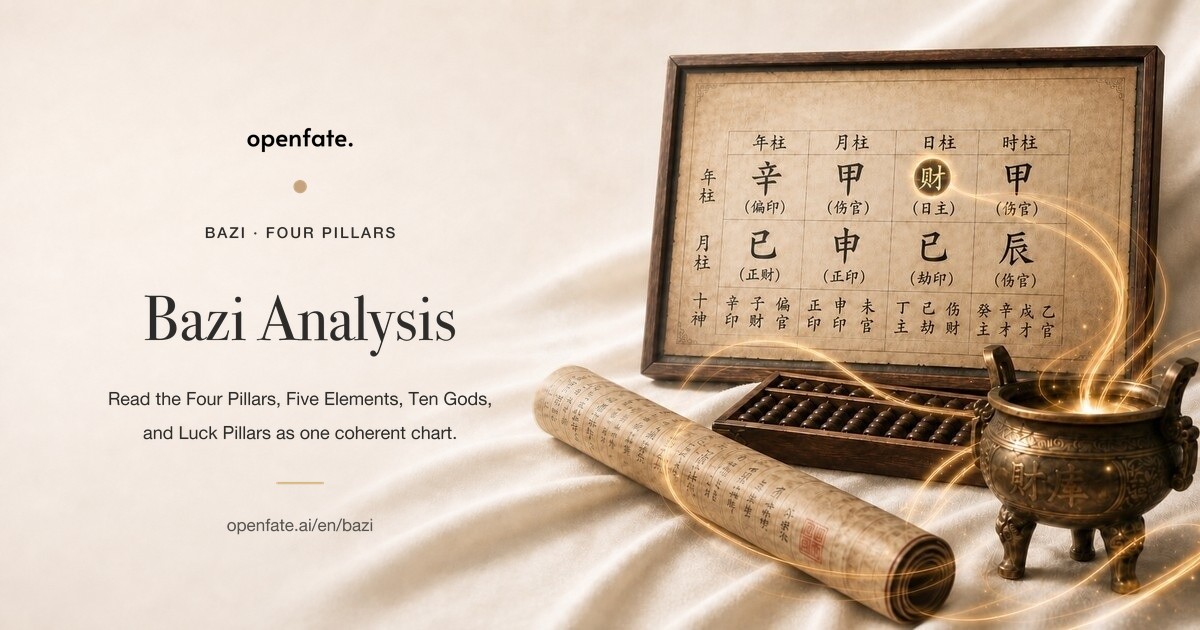
Enter your birth date, recorded time, and birthplace to calculate a Four Pillars chart. Review the Day Master, Ten Gods, Hidden Stems, Five Elements, Luck Pillars, and the calculation conventions used.
We take pride in delivering thoughtful reports that help people see their timing, patterns, and next steps more clearly.
GitHub Open SourceEach tool begins with declared inputs and deterministic rules. Birth-chart systems keep their calculated structure visible; AI explains those results without rewriting the underlying facts.
Birth details, questions, selections, or cast inputs are normalized for the relevant tool.
Each tool produces its chart, draw, cast, or core facts from its declared rules.
AI interprets the visible facts and structure without changing the deterministic inputs.
Interpret the Day Master, Ten Gods, Five Elements, and Luck Pillars while keeping chart facts separate from reflective guidance.
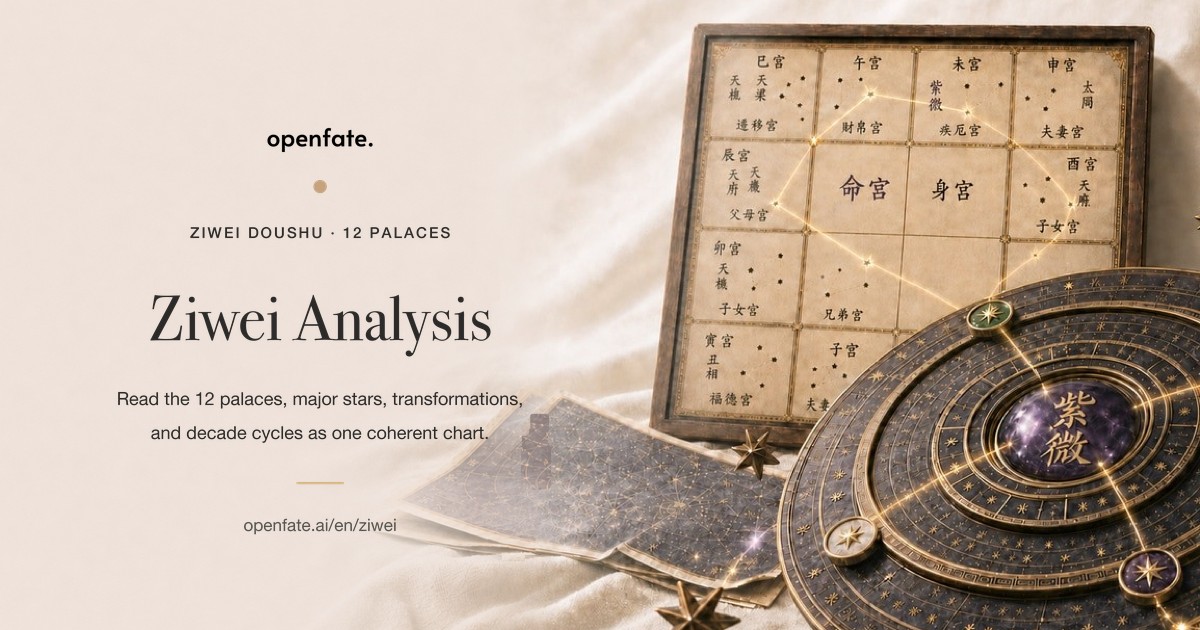
Interpret the Life and Body Palaces, palace relationships, stars, Four Transformations, decade cycles, and annual cycles without mixing chart facts with explanation.
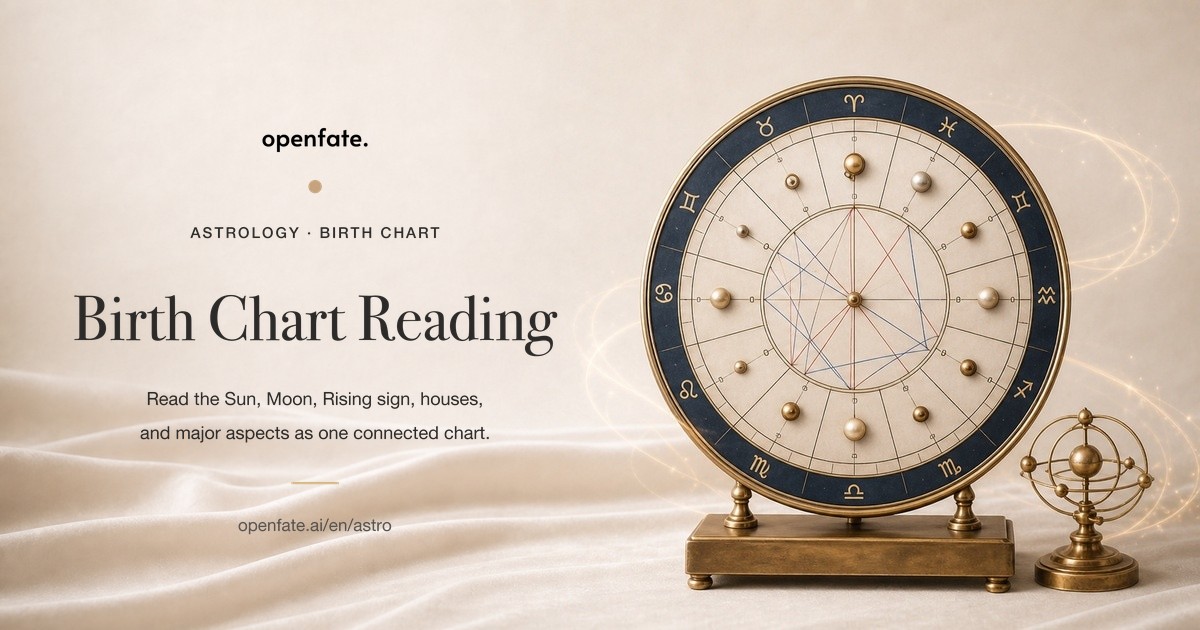
Read the Sun, Moon, Rising sign, planetary placements, houses, and major aspects while keeping chart data separate from interpretation.
Compare 2-3 independently calculated systems axis by axis. Similar themes add perspective but do not establish empirical reliability.
Read the lagna, Moon nakshatra, divisional charts, and dasha periods while keeping calculated chart data separate from interpretation.
Understand your natural rhythm, decision timing, and pressure pattern in plain language, with practical guidance for work, relationships, and this week.
Start with a calculated Shukuyo birth mansion and explore the traditional 27-mansion themes without turning symbolism into certainty.
Compare Tarot, Meihua I Ching, Liu Yao, Lenormand, Qimen Dunjia, and Guanyin lots by how each begins and what it helps you examine. Every method shows its fixed result before any optional AI reading.
Generate a Bazi archetype card and inspect chart-signal consistency; the result is reflection, not diagnosis or measurement.
Look up Huangli fields while keeping calendar data separate from traditional interpretation.
Compare symbolic daily themes and time windows, then verify real conditions before acting.
Editorial research on Bazi, relationships, wealth, annual timing, and Eastern metaphysics.
A production-grade Bazi calculation server for Claude, Cursor, Codex, Cline, and every MCP-compatible AI agent.
Everything you need to know about reports, credits, and how it works.
Credits & Account
Usage & Features
Charting & Algorithm Logic
Technical & Developers
Troubleshooting
Privacy & Legal
About Me
Enter a birth date, recorded local time, and birthplace to generate a free Four Pillars chart. OpenFate calculates the chart before any optional AI interpretation and shows the calendar, True Solar Time, solar-term month rule, and day-boundary convention used.
Bazi, or Four Pillars, represents the birth year, month, day, and hour as four Heavenly Stem and Earthly Branch pairs. Those eight characters form the calculated chart; interpretation is a separate step.
A trustworthy calculator should make its inputs and conventions inspectable. This matters most for births near an hour, day, solar-term, or historical time-zone boundary, where a small change in the adjusted time can change a pillar.
Enter the calendar type, birth date, recorded local time, and birthplace. This chart calculator requires a birth time; if it is unknown, use the dedicated Birth-Time Calibration tool instead of inventing one. Birthplace provides longitude and time-zone context, while the date determines which historical civil-time and solar-term rules apply. If the source record is lunar, identify a leap month rather than converting it by guesswork.
Civil clock time, local solar time, and the Bazi day boundary are separate choices. OpenFate records whether True Solar Time is applied, which day-boundary mode is selected, and that the Month Pillar follows solar terms rather than the numbered lunar month.
In a fixed calculation example, 2024-06-15 at 23:45, longitude 112°E, and UTC+8 becomes 23:12 after True Solar Time correction. With a 23:00 day rollover, the Day Pillar is 辛亥 (Xin-Hai); with a 00:00 rollover, it is 庚戌 (Geng-Xu). The birth record is unchanged—the declared boundary rule explains the different result.
Begin with the four pillars and the Day Master, then examine seasonal context, Ten Gods, Hidden Stems, Five Element structure, and branch interactions. Review Luck Pillars only after confirming the natal chart and calculation basis. A simple element count is not, by itself, a complete strength or useful-element judgment.
When another calculator disagrees, change one setting at a time: calendar type, leap-month status, birth place, time-zone or DST treatment, True Solar Time, and day-boundary mode. If the adjusted time crosses an hour, day, or solar-term boundary, a different pillar may be the expected result of a different convention.
The chart is reproducible under the stated inputs and rules. Personality, relationship, career, wealth, and future-event statements are traditional interpretations rather than guaranteed outcomes. Use them for reflection, not as medical, legal, financial, or safety advice.
Answers about calculation rules, uncertain birth times, and differences between Bazi calculators.
It shows the calculated Four Pillars, Day Master, Ten Gods, Hidden Stems, Five Element structure, branch interactions, and Luck Pillars supported by the supplied birth data. If the birth time is unknown, use the Birth-Time Calibration tool rather than entering an estimate and treating the resulting Hour Pillar as exact.
They may use different calendar inputs, historical time-zone or DST data, birth coordinates, True Solar Time settings, solar-term boundaries, or 23:00 versus 00:00 day rollover. Compare the inputs and conventions before deciding that either chart is wrong.
True Solar Time is one declared calculation convention. It adjusts civil time using birthplace longitude and the equation of time, which can change a pillar near a boundary. Some schools and tools intentionally use civil time instead, so OpenFate keeps the selected convention visible.
This chart calculator requires a birth time. If it is unknown, do not enter an invented noon or midnight; use the Birth-Time Calibration tool to compare candidate hours and preserve the uncertainty. A possible birth after 23:00 can affect the Day Pillar; a solar-term transition can affect the Month Pillar and, around Li Chun, the Year Pillar.
Yes. Select the calendar printed in the original record and identify a lunar leap month when applicable. The calculator normalizes that date before deriving the pillars, while the Month Pillar follows solar-term boundaries rather than the numbered lunar month.
No. The chart engine calculates the pillars and structured chart facts first. Any optional AI reading receives those results for explanation; it does not replace the deterministic calculation.