Bazi AcademyHeavenly Stems
Ten Heavenly Stems Explained: Jia, Yi, Bing, Ding, Wu, Ji, Geng, Xin, Ren, and Gui
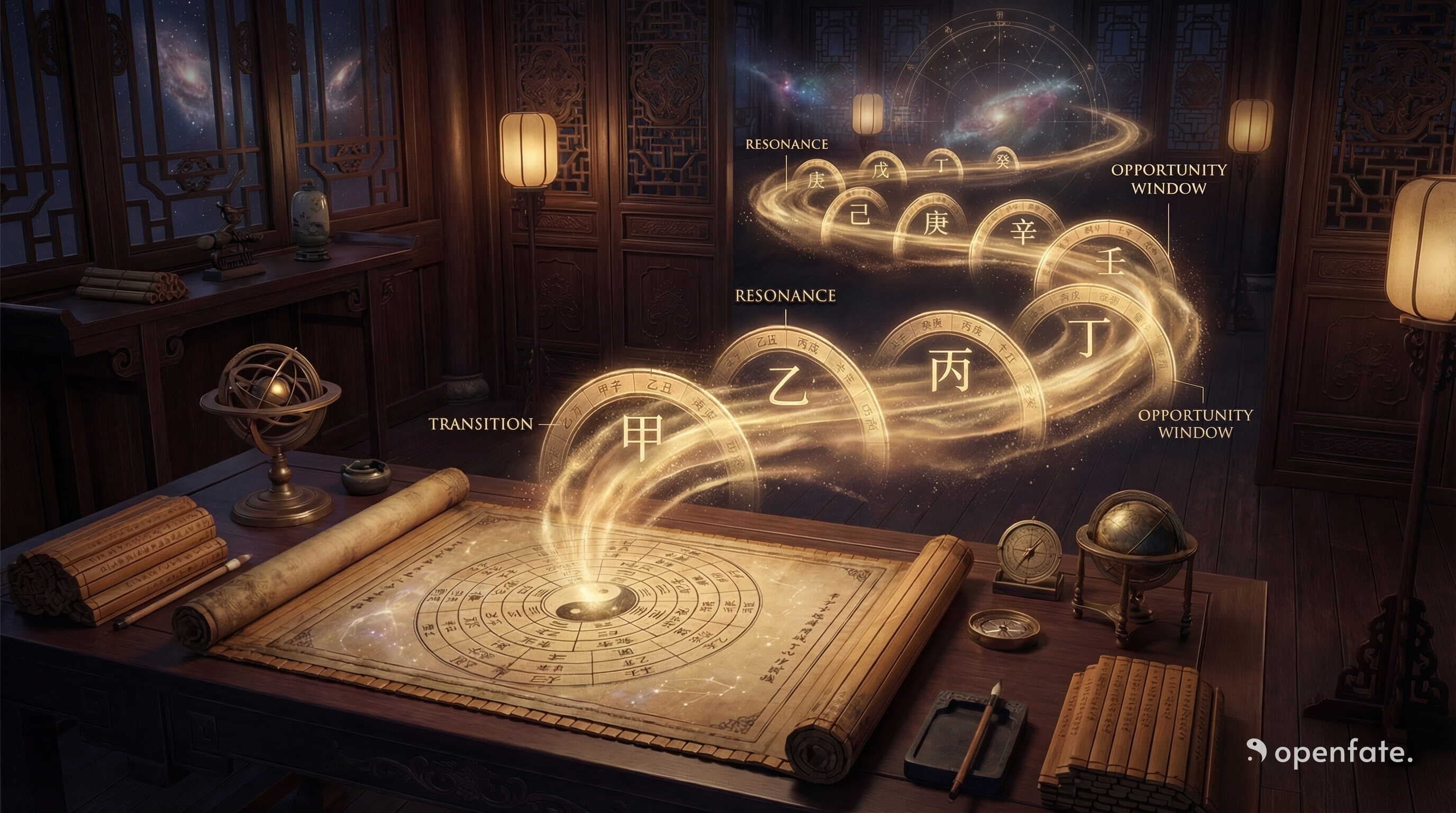
Core Answer
The Ten Heavenly Stems are the specific Yin-Yang manifestations of the Five Elements, dictating your most external social architecture and mental facade. As San Ming Tong Hui records, Stems \'move and act,\' making them the fastest and most highly accurate tool for decoding external personality logic.
Introduction
When people first begin learning Bazi, they usually run into two basic systems right away: the Ten Heavenly Stems and the Twelve Earthly Branches.
The Heavenly Stems are the first layer of visible symbols: Jia, Yi, Bing, Ding, Wu, Ji, Geng, Xin, Ren, Gui.
They are not just a chart to memorize; they are the Five Elements expressed through Yin and Yang.
What the Ten Heavenly Stems are
Relationship between Elements and Yin-Yang
What each stem specifically represents
What the stems show in a Bazi chart
What Are the Ten Heavenly Stems?
The Ten Heavenly Stems are the Five Elements divided into Yin and Yang.
Each element has two modes: Yang and Yin. This creates ten total expressions.
Five Elements × Yin-Yang = Ten Heavenly Stems
Elements and Yin-Yang Relationship
The Element tells you what kind of force (Wood, Fire, etc.).
Yin-Yang tells you how that force behaves (direct vs. subtle).
The element tells you "what kind." Yin-Yang tells you "how it shows up."
Stems Detailed
Jia Wood: Tall, Upright tree
Yang Wood. Symbolizes a tall tree. Represents direct, upright, structural growth and expansion. Imbalance leads to being rigid, stubborn, or unable to bend.Yi Wood: Flexible, Adaptive flowers
Yin Wood. Symbolizes flowers, vines, or branches. Represents soft, adaptive, resilient, and subtle energy. Imbalance leads to overthinking, indecision, or being overly accommodating.Bing Fire: Bright Sun Fire
Yang Fire. Symbolizes the sun. Represents bright, public, broad, and visible warmth and action. Imbalance leads to being impulsive, excessive, or too exposed.Ding Fire: Focused Lamp Fire
Yin Fire. Symbolizes candlelight or a lamp. Represents focused, persistent, internal, and precise warmth. Imbalance leads to anxiety, sensitivity, or being internally overheated.Wu Earth: Heavy Mountain Earth
Yang Earth. Symbolizes high mountains or solid ground. Represents stable, enduring, supporting, and grounded strength. Imbalance leads to being slow-moving, conservative, or blocked.Ji Earth: Fertile Cultivated Soil
Yin Earth. Symbolizes garden soil or fertile land. Represents organization, nurturing, absorption, and responsiveness. Imbalance leads to overprocessing, mental heaviness, or inertia.Geng Metal: Sharp Blade Metal
Yang Metal. Symbolizes a sword or axe. Represents sharp execution, boundaries, and decisive strength. Imbalance leads to being harsh, overly blunt, or severe.Xin Metal: Refined Jewelry Metal
Yin Metal. Symbolizes polished jewelry or fine metal. Represents refinement, standards, precision, and elegance. Imbalance leads to being critical, sensitive, or obsessed with perfection.Ren Water: Large Flowing Ocean
Yang Water. Symbolizes the ocean or large rivers. Represents liquidity, broad vision, strategy, and fluid movement. Imbalance leads to being scattered, directionless, or spread too thin.Gui Water: Fine Permeating Dew
Yin Water. Symbolizes rain, mist, or morning dew. Represents subtle, sensitive, quiet, and intuitive perception. Imbalance leads to hypersensitivity, internal instability, or fluctuation.
Bazi Fundamentals Series
How to Learn for Beginners
- Mapping: Jia/Yi = Wood, etc.
- Contrast: Yang is direct; Yin is internal.
- Visuals: Jia is a tree; Ding is a lamp.
Final Thoughts: Ten Expressions of the Five Elements
Understanding the Ten Heavenly Stems is your true entrance into Bazi logic. They are not just symbols, but living energetic flows.
Next, we will explore the Twelve Earthly Branches, the deeper roots of life energy.
FAQ
What are the Ten Heavenly Stems?
The ten stem symbols representing the Five Elements divided into Yin and Yang.
How do they relate to the Five Elements?
Jia/Yi = Wood, Bing/Ding = Fire, etc. The first is Yang, the second is Yin.
Why are Jia Wood and Yi Wood different?
Jia is Yang (upright/direct); Yi is Yin (flexible/adaptive).
Read Your Heavenly Stems
Accurate chart calculation is the essential starting point.
 Read My Heavenly Stems
Disclaimer: Metaphysics is a traditional cultural perspective, not a substitute for modern science. Content is for reference only; please exercise rational judgment based on your specific situation.