Bazi AcademySexagenary Cycle
What Is the Sexagenary Cycle? A Clear Guide to the 60 Jiazi System
Core Answer
The Sexagenary Cycle consists of 60 unique pillar combinations, forming the foundational chronometric code of Bazi. As stated in Di Tian Sui, one must observe their internal mechanisms; each pillar holds its own microscopic dynamic of generation and restriction.
Introduction
Once people learn the Five Elements, the Ten Heavenly Stems, and the Twelve Earthly Branches, they run into the next question: What is the Sexagenary Cycle?
You start seeing combinations like Jiazi, Yichou, and Bingyin. Many people know they relate to stems and branches, but do not fully understand how the 60 units are formed or why they matter in a chart.
If the Five Elements are the foundational language, and the Stems and Branches are the core components, the Sexagenary Cycle is the complete time framework created when they move in sequence.
What Is the Sexagenary Cycle?
The simplest answer is that the Sexagenary Cycle is the full 60-step cycle created when the Heavenly Stems and Earthly Branches rotate together in fixed sequence.
The 10-step Stems and 12-step Branches take 60 steps to overlap at the same starting position again.
It is not an abstract list, but a rotating combinational framework produced by 10 and 12.
Why Are There 60 Jiazi units?
The stems follow a 10-beat rhythm while the branches follow a 12-beat rhythm. They move together in fixed parallel order.
To return to the same starting point — Jiazi — they must complete the least common multiple of 10 and 12, which is 60.
How Is the Sequence Formed?
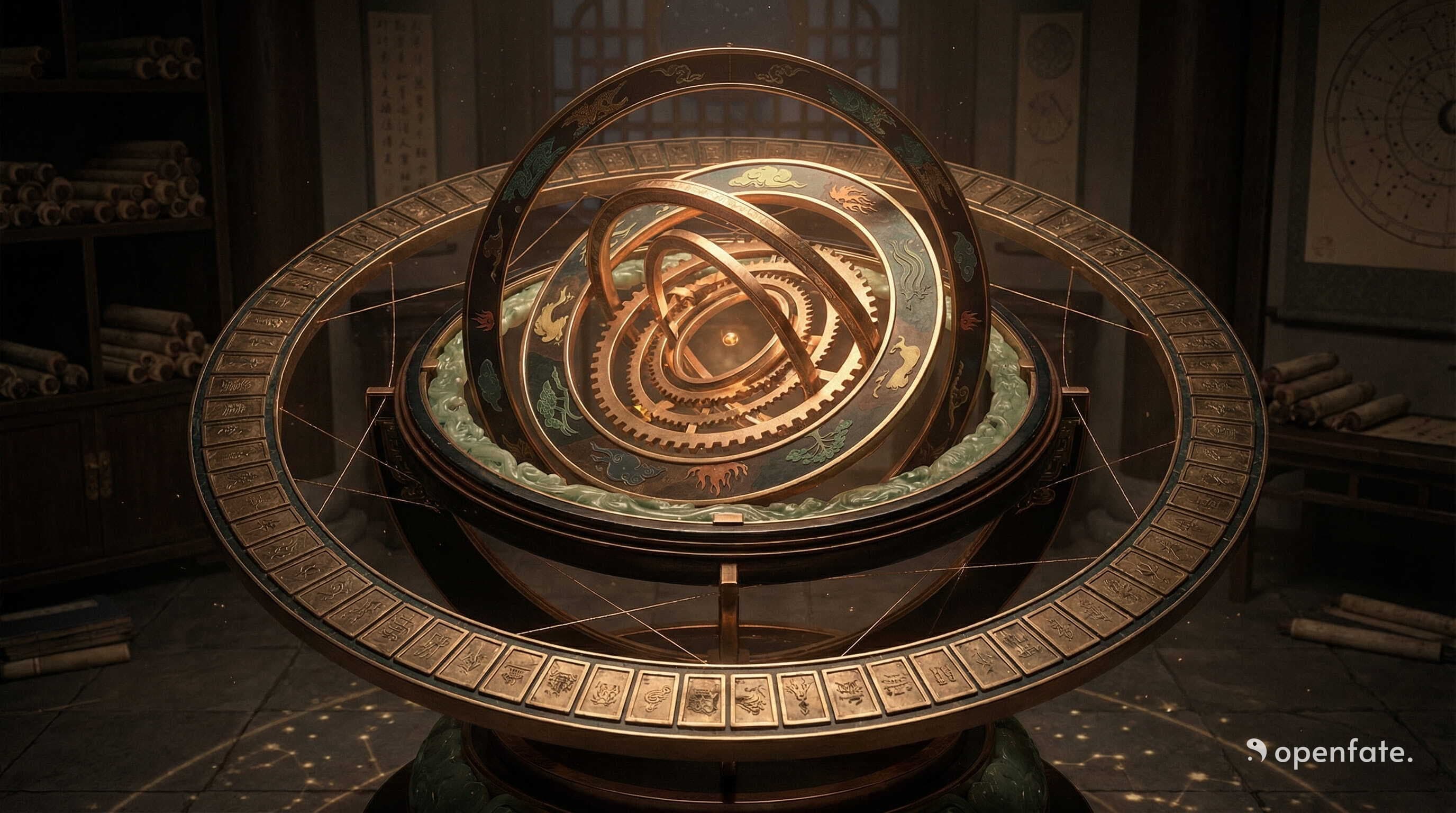
Imagine two gears: one with 10 teeth (Stems) and one with 12 teeth (Branches). Each step creates a new pair.
- 1. Jiazi
- 2. Yichou
- 3. Bingyin
- 4. Dingmao
- 5. Wuchen
- 6. Jisi
- 7. Gengwu
- 8. Xinwei
- 9. Renshen
- 10. Guiyou
- 11. Jiaxu
- 12. Yihai
The cycle continues until all 60 combinations are completed. It is a systematic, sequential mechanism.
What Do the Combinations Mean?
Each unit is fundamentally one Heavenly Stem plus one Earthly Branch.
Jiazi
Jia (Yang Wood) + Zi (Water)Yichou
Yi (Yin Wood) + Chou (Earth)Bingyin
Bing (Yang Fire) + Yin (Wood)Dingmao
Ding (Yin Fire) + Mao (Wood)
Each unit is a structural package containing specific elemental and Yin-Yang information, seasonal conditions, and hidden stems.
How Does It Relate to Bazi?
The Four Pillars in Bazi are four stem-branch combinations.
Think of the Sexagenary Cycle as the base library of building blocks. Without this cycle, there is no way to represent a birth chart.
Is It Only for Years?
This is a common misconception. In the traditional system, the cycle is used for years, months, days, and hours.
It is a full time-coding system. All four pillars in a chart can be expressed through these units.
What Does It Show in Bazi?
Base units of the Four Pillars: The core structure of Year, Month, Day, Hour.
Language of time cycles: Used for Luck Pillars and annual shifts.
Elemental and Yin-Yang encoding: Provides immediate structural information.
Deeper branch content: Carries rooting and hidden stem data.
Why Does the Same Stem Feel Different in Different Pairs?
This is the most interesting part of the system. Jia Wood in "Jiazi" and "Jiawu" has completely different environmental conditions.
Zi Water in "Jiazi" and "Bingzi" functions differently because the stem changes the interaction.
How Should Beginners Learn?
Step 1: Understand the Heavenly Stems and Earthly Branches separately.
Step 2: Understand the combinational logic of the gear rotation.
Step 3: Connect it back to the Four Pillars to see it function.
Accuracy Depends on Your Calculation
Exact birth time, solar term boundaries, and True Solar Time are vital for identifying the correct stem-branch pairs.
If the chart is slightly off, the stem-branch combinations change completely.
Final Thoughts: A Living Time Framework
Memorizing the 60 names is less important than understanding how the cycle functions as a time system.
Once you understand the cycle, Bazi stops being static symbols and becomes a moving framework of time.
Bazi Fundamentals Series
FAQ
What is the Sexagenary Cycle?
The full 60-unit cycle created by pairing 10 Heavenly Stems and 12 Earthly Branches in sequence.
Why are there 60 units, not 120?
Because the stems and branches rotate in parallel. Their least common multiple is 60 steps to reach the starting point again.
How does it relate to Bazi?
The Four Pillars are composed of stem-branch pairs, each being a specific unit within the 60 Jiazi system.
Do they reflect zodiac animals?
Yes, but the zodiac is just the branch part. The full Jiazi unit gives the complete elemental and Yin-Yang picture.
Discover Your Stem-Branch Structure
Calculate your accurate Bazi chart to identify your pillars within the 60 Jiazi cycle.
 Check My Four Pillars
Disclaimer: Metaphysics is a traditional cultural perspective, not a substitute for modern science. Content is for reference only; please exercise rational judgment based on your specific situation.