Bazi AcademyTwelve Earthly Branches
Twelve Earthly Branches Explained: What Zi, Chou, Yin, Mao, Chen, Si, Wu, Wei, Shen, You, Xu, and Hai Really Mean
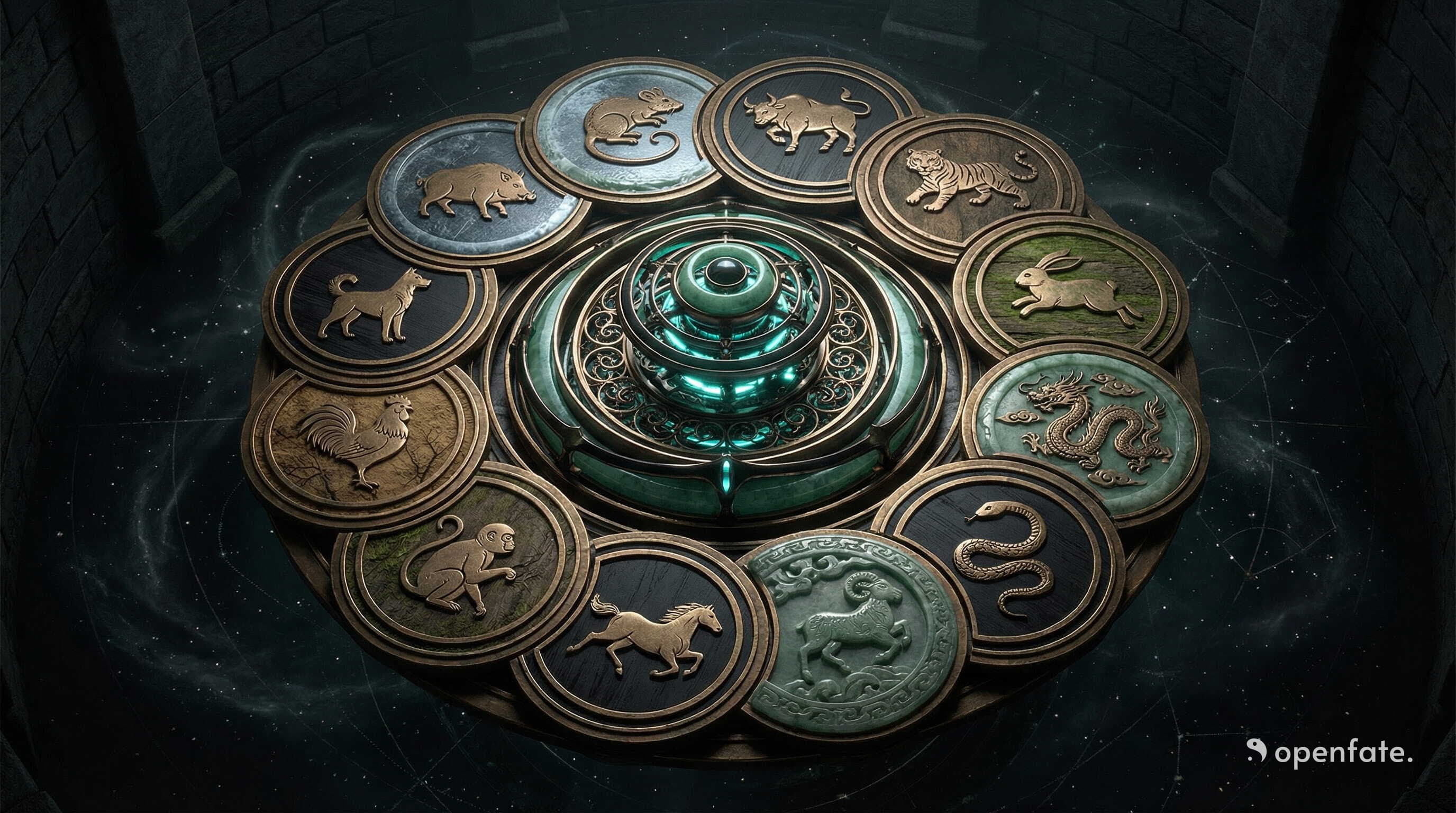
Core Answer
The Twelve Earthly Branches codify seasons, timing, and hidden elemental roots, serving as destiny\'s physical container. As Yuan Hai Zi Ping states, mastering their hidden stems and complex clash-combination dynamics unlocks an individual\'s subconscious drives and unseen environmental resource fluctuations.
Introduction
If the Five Elements are the foundational language of Bazi, and the Ten Heavenly Stems are its more visible expression, then the Twelve Earthly Branches are the deeper, more complex structural layers.
Beginners often start by memorizing the Stems and Branches. But questions quickly arise: How are they different? Why are they more than just zodiac animals?
In Bazi, Earthly Branches are not just labels; they are structural containers where elemental forces are stored and rooted. Heavenly Stems are what is visible above ground, while Branches are the deep foundation.
What Are the Twelve Earthly Branches?
The Twelve Earthly Branches are twelve structural units used to describe time rhythm, seasonal transition, and elemental environment.
They represent twelve stages of cyclical time and different environmental states of elemental force within those stages.
If Heavenly Stems are visible expressions above ground, Earthly Branches are the soil structure beneath the surface.
How Are the Earthly Branches Different from the Heavenly Stems?
Heavenly Stems are like the visible trunk and leaves of a tree; Earthly Branches are like the soil, roots, and underground conditions.
Heavenly Stems are more visible
Surface expression
Direct force
Visible activity
Outer layer
Earthly Branches are more structural
Foundation
Environment
Rooting
Hidden storage
Twelve Earthly Branches
Zi: Peak Water, Deep Cold
Yang Water. Represents the deepest and coldest phase of Water force. Keywords: Cold, Depth, Flow, Hidden movement, Stored momentum.Chou: Damp Earth, Storing Moisture
Yin Earth (Damp). Complex internal structure containing Water and Metal. Keywords: Moisture, Storing, Slowness, Transition, Internal weight.Yin: Rising Wood, Early Spring
Yang Wood. The beginning of spring movement with strong rising intent. Keywords: Activation, Rising, Action, Growth impulse.Mao: Pure Wood, Open Growth
Yin Wood. More stable and pure Wood, like an unfolding sprout. Keywords: Extension, Softness, Open growth, Expansion.Chen: Mixed Damp Earth, Transitional Complexity
Yang Earth (Damp). Late spring Earth with mixed Water and Wood residues. Keywords: Transition, Mixture, Container, Hidden change.Si: Rising Fire, Increasing Heat
Yin Fire. The stage where heat is rising but still carries internal complexity. Keywords: Heat, Upward movement, Activation, Emerging pressure.Wu: Peak Fire, Full Visibility
Yang Fire. The strongest expression of Fire among the Branches. Keywords: Intensity, Peak activation, Visibility, Direct expression.Wei: Dry Earth, Residual Heat
Yin Earth (Dry). Late summer Earth carrying dry heat. Keywords: Dryness, Containment, Digestion, Buffering, Support.Shen: Activating Metal, Beginning of Contraction
Yang Metal. The beginning of Metal movement toward contraction and results. Keywords: Contraction, Result-oriented, Execution, Shift.You: Pure Metal, Formed and Refined
Yin Metal. Refined and stable Metal, focused on standards and precision. Keywords: Refinement, Accuracy, Pure, Defined, Standard.Xu: Dry Earth, Internal Tension
Yang Earth (Dry). Late autumn Earth with strong internal tension and closure. Keywords: Closure, Hardness, Solid, Storing, End-stage.Hai: Opening Water, Incoming Cold
Yin Water. Water force opening up as environmental cold increases. Keywords: Flow, Openness, Nourishment, Large-scale connection.
How Do the Branches Relate to the Five Elements?
Earthly Branches are categorized by season and element, though many are "mixed" rather than pure.
Wood
Yin, Mao (Spring)Fire
Si, Wu (Summer)Earth
Chou, Chen, Wei, Xu (Seasonal Transitions)Metal
Shen, You (Autumn)Water
Zi, Hai (Winter)
What Are Hidden Stems?
Hidden stems refer to the internal elemental contents stored inside each Earthly Branch. A Branch is not an empty shell.
An element might not appear in the Stems, but it may exist structural support in the Branches.
Hidden stems are crucial for judging rooting and potential forces in a chart.
Why Are Earthly Branches So Important?
Heavenly Stems are like cards on the table; Earthly Branches are like the hidden vault. They determine real support and rooting.
Determines Rooting: Support in the Branches is essential for a stable Day Master.
Determines Environment: The Month Branch sets the seasonal tone for the entire chart.
Determines Structure: Interactions like Clashes and Combinations define the chart's life path.
Earthly Branches vs. Zodiac Animals
They are not the same. Zodiac animals are just a popular cultural simplification. In Bazi, the Branch's elemental and structural meaning is far more significant.
Serious Bazi learning requires moving from "zodiac thinking" to "branch thinking."
How Should Beginners Learn?
Memorize the Order: Zi, Chou, Yin, Mao, Chen, Si, Wu, Wei, Shen, You, Xu, Hai.
Learn Seasons/Elements: Map them to their corresponding elemental phases.
Learn Relationships: Study how Branches interact (Clash, Combine, Punish).
Accuracy Depends on Your Calculation
Exact birth time and solar boundaries are vital to identifying the correct Earthly Branches.
Final Thoughts: The Branches Are the Structural Base
The Twelve Earthly Branches are the base units of time rhythm and elemental environment.
Once you understand this layer, you can see the deep internal architecture of any Bazi chart.
Bazi Fundamentals Series
FAQ
What are the Twelve Earthly Branches?
The twelve symbols in the stem-branch system representing seasonal cycles and elemental environments.
What are hidden stems?
Internal elemental forces stored within Each Earthly Branch, providing hidden support to the chart.
How are they different from Heavenly Stems?
Stems are visible and direct; Branches are structural, hidden, and foundational.
Do they reflect zodiac animals?
Yes, but the zodiac is a simplification. The real value lies in their elemental and structural depth.
Discover Your Earthly Branch Structure
Calculate your accurate Bazi chart to identify your rooting and hidden elemental support.
 Check My Branch Structure
Disclaimer: Metaphysics is a traditional cultural perspective, not a substitute for modern science. Content is for reference only; please exercise rational judgment based on your specific situation.