Personality TestSBTI
What Is SBTI? The Viral Personality Test Explained
Core Answer
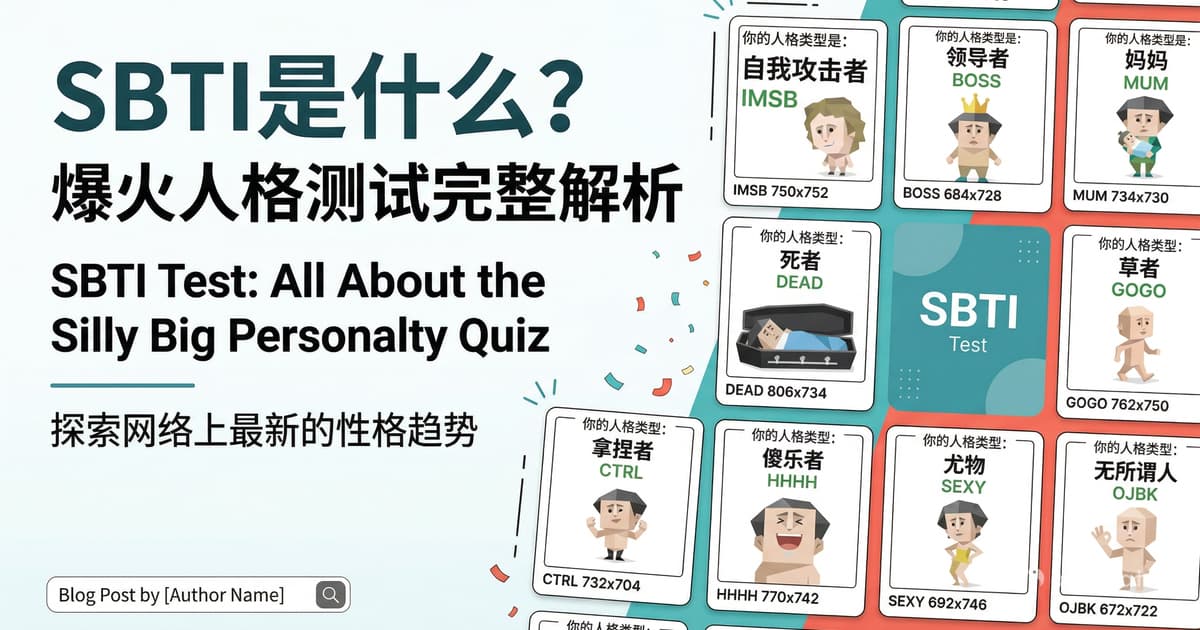
SBTI (Silly Behavioral Type Indicator) is a viral, meme-first personality test evaluating users across 15 dimensions to return one of 27 satirical outcomes. Unlike MBTI, it avoids clinical assessment, focusing strictly on entertainment, social sharing, and internet-native archetypes.
Introduction
SBTI is a viral online personality test that presents itself as a lighter, more satirical alternative to traditional personality systems. On its official English pages, SBTI describes itself as a “light, satirical personality test” and says the experience is meant for entertainment, comparison, and self-observation rather than serious psychological assessment.
Unlike older personality frameworks that rely on more formal or clinical language, SBTI uses internet-native humor, exaggerated labels, and meme-like archetypes. The official site says the test maps users across 15 dimensions grouped into five personality models and returns one of 27 outcomes. The full flow is described as 32 prompts, including a hidden supplemental branch.
Why is this "unscientific" test dominating social media?
What does SBTI stand for?
The broader SBTI ecosystem presents the format as the Silly Behavioral Type Indicator or Silly Big Personality Test, depending on the page and publisher. The official sbti.dev site uses “Silly Behavioral Type Indicator,” while Nano Banana’s version calls it an unscientific MBTI parody built for humor and fast sharing.
How does the SBTI test work?
According to the official SBTI pages, the test evaluates users through five model groups: Self Model, Emotion Model, Attitude Model, Action Model, and Social Model. Each group has three dimensions, creating a 15-dimension profile that appears after the quiz is completed.
In simple terms, SBTI is not just trying to label whether someone is introverted or extroverted. It looks at how stable your self-view is, how you react in relationships, how you respond to rules and meaning, how you take action, and how you behave around other people. The official result pages and type directory then convert that profile into one of 27 named archetypes.
What are the 27 SBTI personality types?
The official type library lists 27 outcomes, including examples such as CTRL, ATM-er, BOSS, OH-NO, SEXY, LOVE-R, FAKE, MALO, THIN-K, DEAD, and DRUNK. The type page presents each as a distinct internet-flavored archetype rather than a clinical personality category.
That tone is part of why SBTI feels different. Instead of giving users a polished corporate-sounding label, it gives them a result that sounds like a meme, a roast, or a social-media in-joke. That makes the test easier to screenshot, easier to post, and easier for friends to react to. This is an inference from the way the official type pages and result pages are written, and from the fact that the platform explicitly supports downloadable share cards and public rankings.
Why is SBTI going viral?
A big reason is speed. The official and affiliated pages frame SBTI as a fast, low-friction test that can be completed in a few minutes, with no heavy setup and an immediate result. The Nano Banana page also emphasizes instant sharing, retakes, and a meme-first voice.
Another reason is tone. The official site says SBTI avoids overly clinical language and focuses on recognizable everyday reactions, attachment patterns, decision habits, and social boundaries. Nano Banana pushes the same idea further, describing the test as “No Science, All Vibes” and positioning it as a funnier, more chaotic alternative to MBTI.
A reasonable reading of the trend is that SBTI works because it combines three things people already like online: identity labels, humor, and social sharing. Instead of asking users to take personality theory seriously, it gives them a result that is easy to laugh at, easy to recognize, and easy to repost.
SBTI vs MBTI: what is the difference?
MBTI is a long-established personality framework built around 16 types and a more formal type language. SBTI borrows the appeal of type-based self-reflection, but the official SBTI description says it speaks in a looser, more meme-native voice and focuses more on recognizably human behavior than corporate taxonomy.
That means MBTI is usually approached as a structured framework people use for self-description, while SBTI is better understood as a cultural product: part quiz, part joke, part social signal. Even the official SBTI pages explicitly note that it is best used for entertainment and is not a replacement for serious psychological assessment.
Is SBTI scientifically valid?
The short answer is no. The official site itself says SBTI works best as entertainment, comparison, and self-observation, not as a serious psychological assessment. Nano Banana’s landing page is even more direct, calling it a hilariously unscientific MBTI parody.
That does not mean the test is useless. It means the value of SBTI is cultural and reflective rather than scientific. For many users, the appeal is not precision but recognition: the result feels emotionally legible, socially shareable, and instantly funny.
What can you actually learn from SBTI?
SBTI can still be useful if you use it the right way. It can show which kinds of descriptions, jokes, or behavior patterns you instinctively identify with. It can also reveal the online persona you are most likely to recognize in yourself at a given moment. The official SBTI framework reinforces this by focusing on self-perception, relationships, habits, action style, and social boundaries rather than formal diagnosis.
But if you are making real decisions about career direction, business timing, relationships, or long-term personal patterns, you usually need a deeper framework than a viral meme test. The useful next step is moving from a temporary label to a more structural reading of how you operate over time.
Final thoughts
SBTI is viral because it turns personality testing into something faster, funnier, and more socially legible. Officially, it offers 27 outcomes, 15 dimensions, five model groups, and a playful tone that is designed for entertainment rather than clinical use.
If MBTI was built for self-description, SBTI feels built for the internet. And that is exactly why so many people are taking it, posting it, and talking about it right now.
Related Reading
FAQ
What is SBTI?
SBTI is a viral satirical personality test that maps users across 15 dimensions and 27 outcomes. It is designed for entertainment, not clinical diagnosis.
How many SBTI personality types are there?
The official type library lists 27 personality outcomes.
Is SBTI the same as MBTI?
No. SBTI is a lighter, meme-native personality test, while MBTI is a more established framework with 16 types.
Is SBTI scientifically accurate?
No. The official site says it is for entertainment and self-observation, not serious psychological assessment.
Go Beyond Labels
SBTI is fun, but if you want to uncover the deeper patterns behind your relationships, career, and long-term direction, the next step is a more structural reading.
 Read Your Destiny Chart Now
Disclaimer: Metaphysics is a traditional cultural perspective, not a substitute for modern science. Content is for reference only; please exercise rational judgment based on your specific situation.