Personality TestSBTI
SBTI vs MBTI: Why the Viral Test Feels So Accurate
Core Answer
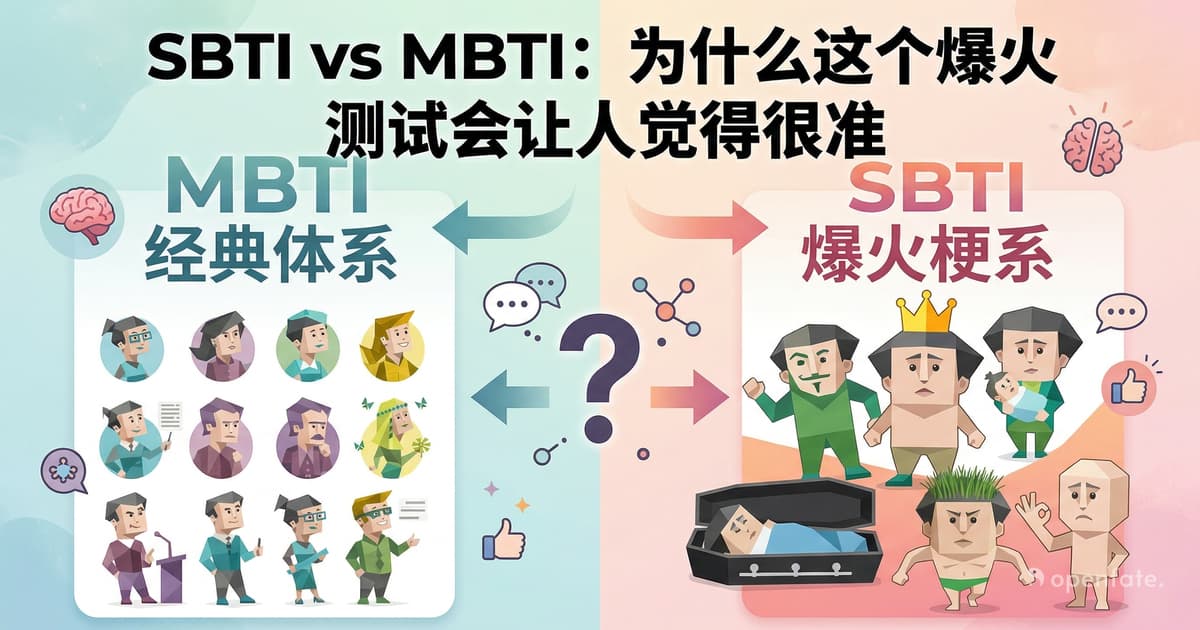
MBTI is a 16-type preference framework built from four preference pairs. SBTI is a 27-result, internet-native personality test built from 32 prompts, 15 dimensions, and five model groups. SBTI often feels more accurate in the moment because its language is faster, sharper, and easier to recognize in everyday life.
Introduction
SBTI and MBTI are both type-based personality formats, but they are built for very different purposes. SBTI presents itself as a playful personality test built around 32 prompts, 27 types, 15 dimensions, and 5 model groups, and it is positioned for entertainment, comparison, and self-observation rather than serious psychological assessment.
MBTI, by contrast, is a 16-type system built from four preference pairs. So the real question is not which one is more famous, but why SBTI makes so many people feel an immediate this is exactly me reaction.
SBTI vs MBTI at a glance
| SBTI | MBTI | |
|---|---|---|
| Core format | Playful online personality test | Preference-based personality framework |
| Number of results | 27 outcomes | 16 types |
| Input structure | 32 prompts | Four preference pairs |
| Main lens | Everyday reactions, attachment, decision habits, social boundaries | Energy, information processing, decision-making, lifestyle orientation |
| Tone | Satirical, meme-native, highly shareable | More formal and descriptive |
| Official positioning | Entertainment, comparison, self-observation | Personality type framework |
Why does SBTI feel so accurate?
The short answer is that SBTI is built to feel socially legible very quickly. Its framing avoids overly clinical language and instead focuses on everyday reactions, attachment patterns, decision habits, and social boundaries, so the result lands in situations users instantly recognize from real life.
That means SBTI is not asking people to decode abstract personality jargon first. It is asking them to react to a version of themselves that already feels familiar, and that recognition speed is a big part of why it feels accurate.
SBTI is easier to read emotionally
MBTI asks users to understand themselves through stable preference pairs. SBTI asks users to recognize themselves through familiar social patterns: how anxious or secure they feel in relationships, how they react to rules, whether they move toward growth or away from risk, and how they behave around other people.
That difference matters. MBTI often feels like a system you learn. SBTI feels like a system you instantly get. That makes it especially effective on social platforms, where recognition speed matters more than theoretical depth.
SBTI also feels accurate because it is optimized for sharing
SBTI results are packaged in a way that makes them easy to screenshot, repost, compare with friends, and discuss in comments. When a type label is not only readable but also instantly shareable, it starts behaving like social content instead of just test output.
That matters because people often decide whether a result feels true by seeing how quickly other people recognize it too. A label that travels well also earns social reinforcement faster.
Why MBTI still feels different
MBTI feels different because it is built around a steadier framework. It tries to explain how people direct energy, take in information, make decisions, and approach the outside world, then combines those preferences into 16 types.
That makes MBTI feel more system-like. SBTI, by contrast, feels more like a cultural mirror: it translates personality into fast, vivid, socially recognizable archetypes. One feels like a framework; the other feels like a label system made for the internet.
Is SBTI more accurate than MBTI?
Not in a scientific sense. SBTI is explicitly framed as entertainment, comparison, and self-observation rather than serious psychological assessment.
A better way to say it is this: SBTI may feel more accurate in the moment because it uses language that is faster, sharper, and more culturally current. MBTI may feel more coherent over time because it is built around a more stable preference model.
Why this comparison matters right now
SBTI’s rise shows that modern personality content is not judged only by how complete the framework is, but by how quickly people can recognize themselves in it. Many users do not start with theory. They start with whether a result feels instantly familiar.
That is why SBTI and MBTI keep getting compared. One behaves more like a stable personality system, while the other behaves more like an internet-era emotional mirror. Understanding that contrast is more useful than simply arguing about which one is more accurate.
Final takeaway
SBTI feels accurate because it is designed to be read fast, felt fast, and shared fast. Structurally, it has 32 prompts, 15 dimensions, 5 model groups, and 27 outcomes, while MBTI remains a more formal framework built from four preference pairs and 16 types.
If MBTI is a structured self-description system, SBTI is a high-speed cultural mirror. That is why the viral test often feels so accurate, even when it is framed as playful rather than scientific.
Related Reading
FAQ
Is SBTI the same as MBTI?
No. MBTI uses four preference pairs to form 16 types, while SBTI uses 32 prompts, 15 dimensions, and 5 model groups to produce 27 outcomes.
Why does SBTI feel more accurate than MBTI to some users?
Because SBTI uses more familiar, emotionally legible, and internet-native language, which makes the result feel instantly recognizable.
Is SBTI scientific?
No. It is positioned as entertainment, comparison, and self-observation rather than serious psychological assessment.
Does MBTI have 16 types?
Yes. MBTI combines four preference pairs into 16 personality types.
A viral type label can open the door, but deeper patterns still matter
If you want to move beyond quick personality labels and understand your longer-term relationship, career, and life patterns, the next step is a more structural reading.
 Start Your Free Reading
Disclaimer: Metaphysics is a traditional cultural perspective, not a substitute for modern science. Content is for reference only; please exercise rational judgment based on your specific situation.