Bazi AcademySpouse Palace
How to Read the Spouse Palace in Bazi: Why Some People Don’t Lack Marriage Luck but Have a Long-Term Relationship Seat That Gets Triggered More Easily
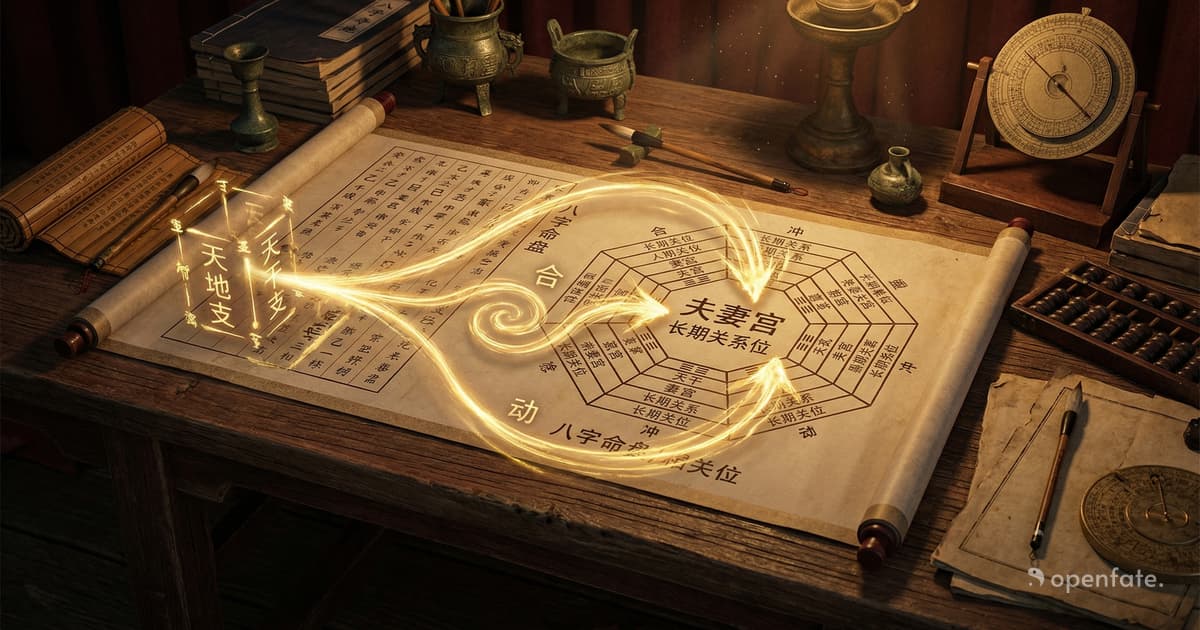
The Spouse Palace: More Than Just "Will I Marry?"
When people hear about the Spouse Palace, their questions are very direct: Is my Spouse Palace good or bad? If it is clashed, does that mean marriage will fail? Why do other people settle naturally while my relationships tighten at key stages?
But if reduced to a one-line verdict on marriage, the reading becomes distorted. The real question is: Is the long-term relationship seat in your chart stable, tight, cold, sticky, or easily activated — and why does that show up in real life as commitment pressure or timing shifts?
This guide explains what the Spouse Palace really means, why it matters, and why some people do not lack marriage luck, but have a seat that is easily triggered.
Core Answer
In common Bazi practice, the Spouse Palace is read through the Day Branch. Do not just look for clashes. Read the Day Branch condition, its relation to the Day Master, the spouse stars, chart interactions, and Luck Pillar timing. Many people do not lack marriage luck; they have a long-term relationship seat that is easier to activate.
What Does the Spouse Palace Mean in Bazi?
The simplest explanation is: The Spouse Palace usually refers to the Day Branch. It matters because in many Bazi systems, it is treated as the intimate relationship seat, the marriage landing point, and the close relational environment.
You can think of it as: the place where your long-term relationship lives inside your chart. It tells us whether long-term commitment tends to settle, or gets easily disturbed when relationship moves close.
Why Is the Spouse Palace So Important?
Because short-term attraction and long-term relationship are not the same thing. A person can have attraction and romance without having a steady structure for cohabitation and shared adult rhythms.
The Spouse Palace directly touches what happens after relationship lands. What happens once intimacy becomes part of real everyday life? It is especially close to how long-term relationship actually settles.
Relationship Between the Spouse Palace and the Day Branch
In Bazi, the Spouse Palace most commonly refers to the Day Branch. The Day Pillar has two parts: the Day Stem (which relates more to the self) and the Day Branch (which relates more to the long-term relationship seat next to the self).
It is related to marriage and partner patterns, but it is not simply "the spouse person", and is not enough on its own to judge the full marriage outcome. It is the landing point of long-term relationship.
What Can the Spouse Palace Show?
The tone of long-term relationship
Whether it tends to feel stable, tight, cold, sticky, dynamic, or easily triggered.The landing quality of marriage
Not just "will there be a relationship", but what happens when relationship enters real shared life.Comfort and tension points in intimacy
Some need breathing space, some are sensitive to disruption, some have lower stillness.Whether the position gets moved easily
Rhythmic breakup patterns, tension prior to marriage, or life changes hitting the seat.
What Can't the Spouse Palace Be Used Alone to Judge?
It cannot alone judge marriage success or failure
Marriage also requires checking spouse stars, combinations/clashes, and timing.A clash does not automatically mean divorce
This is one of the most common fear-based distortions.It does not equal a fixed marriage fate
The same Palace acts differently across structural environments and Luck Pillars.It is not the only marriage answer
It is central, but not total. Use it as part of a holistic reading.
Why Do People Panic When They Hear “The Spouse Palace Is Clashed”?
The word “clash” sounds dramatic, often used as a fear trigger. A more reliable explanation is: a clash to the Spouse Palace does not automatically mean divorce. More often, it means the long-term relationship seat is more likely to move, change, or be affected by outside forces.
This can show up as greater relationship movement or external changes (like relocation) affecting partnership. The seat simply does not stay still as easily.
What Does It Really Mean When It Is Clashed?
The simplest way to understand it is: the long-term relationship seat is easier to move. This movement can stem from rhythm shifts, stress, or life changes rippling directly into the relationship.
Greater stage change in relationship
It is not necessarily bad, but it is not especially quiet or still.Greater impact of external factors
Work, relocation, and family shifts easily disrupt the partnership equilibrium.A relationship seat that is less quiet
Some need a highly compatible match, otherwise the relationship moves whenever their life does.A more dynamic marriage line
It doesn’t mean no marriage luck, but rather that the line doesn’t proceed linearly.
Why Do Some People Have a Seat That Gets Triggered Easily?
Many wonder: I’m not incapable of entering a relationship, but why do things always tighten at key stages? Often the answer is: not a lack of marriage luck, but a relationship seat that is easier to activate.
The Spouse Palace functions like a sensitive or pull-stress seat. Real life looks like easier dating but a highly turbulent long-term landing. They marry through a much more winding path.
Why Do Combinations, Clashes, Punishments, and Harms Matter?
Combination
Not always good. Sometimes means binding, dragging, or entangling.Clash
More like movement, change, outside impact, or unstable rhythm.Punishment
More like long-term awkwardness, internal friction, and pressure.Harm
More like hidden drain, misunderstanding, or subtle disharmony.
These interactions show what kind of relational field the seat lives inside. The real question is whether the seat is supported, or repeatedly pulled and worn down.
Why Is Dating Easy, but Long-Term Relationship Unstable?
Because the Spouse Palace governs how relationship behaves after it lands. These people often have little trouble starting romance. But once they enter long-term commitment, problems pile up.
They don't lack emotional flow—instead, they have an easy entry but a much harder long-term relational landing connected to an unstable Spouse Palace.
Why Are Some Marriages Very Sensitive to Life Rhythm Changes?
Some Spouse Palaces aren't "bad"—they are simply highly sensitive to job changes, relocation, children, money stress, or Luck Pillar activation.
With good compatibility these marriages do well. But if life rhythm is chaotic, the Spouse Palace gets pulled easily, turning stress into structural relationship tension.
4 Examples Users Can Understand Easily
Example 1: Why dates easily but struggles deciding to marry?
Because their Palace is dynamic. Attraction flows well, but the long-term relational landing is resistant or sensitive to pressure.
Example 2: Why do some have turbulent marriages without a "divorce chart"?
Their relationship timeline isn't smooth—perhaps cyclic separations. Their Spouse Palace is just highly dynamic.
Example 3: Why do outside issues affect their deep bond?
Because their Palace allows lower separation between external stressors and the intimate sphere. Lower disturbance tolerance.
Example 4: Why do big relationship steps cluster in certain phases?
Spouse Palaces are timing-sensitive. Major shifts occur when Luck Pillars strongly trigger that relational position.
5 Questions Users Should Remember
Is my Spouse Palace stable, tight, cold, sticky, or easily moved?
Understanding this answers the baseline tone.Do I lack marriage luck, or is my relationship seat easily triggered?
Shift from a "bad luck" mindset to recognizing how easily your boundary is pulled.Is it aligned with my self-core?
This determines if commitment feels comfortable or creates tension.What does my Spouse Palace react to most strongly?
External timing, clashes, internal friction, draining pressure?When do Luck Pillars most strongly activate it?
Marriage timing always hinges on stage-sensitive triggers.
Why Do Luck Pillars Change the Felt Experience?
Someone highly unstable in relationships when young might become incredibly steady later. Or they might feel ready to commit during one phase, but suffocated in another.
Luck Pillars shift whether the Palace is supported, whether outside rhythms hit the marriage seat. The Spouse Palace is core, but Luck Pillars determine if it feels still or movable.
The 8 Most Common Beginner Mistakes
Mistake 1: Clashed = Divorce
False. It usually means greater movement and reaction.Mistake 2: "Good" = Guaranteed Happy Marriage
Incomplete. The whole chart matters.Mistake 3: Ignoring Day Master
Creates dangerous blindspots.Mistake 4: Spouse Palace = The Spouse
It represents the *landing point*, not just the human partner.Mistake 5: All Combinations are Good
False. Combinations can bind or entangle.Mistake 6: Ignoring Timing
It must be read in the context of active life stages.Mistake 7: Easily moved = No Marriage Luck
False. They just have a more dynamic path.Mistake 8: Scaring oneself with labels
It's a diagnostic tool, not a means for spreading fear.
Most Practical Takeaways
First:It is not simply a verdict on marriage—it is about how long-term relationship lands.
Second:It usually refers to the Day Branch, and cannot replace full marriage judgment.
Third:A clash does not mean divorce; it means the seat is easier to move or activate.
Fourth:Many do not lack marriage luck—they simply have an activation-prone seat.
Fifth:The natal chart gives the tone, and Luck Pillars show when it becomes activated.
Start With an Accurate Chart
If you want to know whether you truly lack marriage luck or just have a more sensitive Palace, the first step is to get an accurate Bazi chart.
Interpretations shift if your birth time is inaccurate, no true solar time is used, or Luck Pillar sequence is wrong.
Final Thoughts: How Long-Term Relationship Lands
The exact Bazi answer is that the Spouse Palace represents the landing point of long-term partnership, not a simple pass/fail marriage test.
Look at how your long-term relationship seat lands, why it becomes stable, tense, or mobile, and when it is more likely to be activated by pressures and timing.
Sources & Methodology Notes
This article uses the common Bazi convention that the Spouse Palace refers to the Day Branch, then reads that position inside the full chart rather than as a standalone marriage verdict.
Core convention
The Spouse Palace is treated as the Day Branch: the Earthly Branch beneath the Day Master and the closest chart position for long-term partnership.Interpretation scope
The Spouse Palace describes how long-term relationship settles into daily life. It should not be used alone as a pass/fail indicator for marriage success.Required context
A complete reading also checks spouse stars, Day Master condition, combinations, clashes, punishments, harms, Luck Pillars, and annual timing.Editorial basis
OpenFate applies this article-level convention through its editorial methodology and the related guide to combinations, clashes, punishments, and harms.
Further Reading
FAQ
What is the safest way to read the Spouse Palace?
Read the Day Branch first, then check how it aligns with your self-core, combinations/clashes, and combine it with spouse stars and Luck Pillar timing.
Is the Spouse Palace the same as the Day Branch?
Usually, yes. In Bazi discussions, the Spouse Palace is effectively analyzing the Day Branch.
Does a clash to the Spouse Palace mean divorce?
No, a clash means movement and activation. It implies that your relationship seat is easily disturbed, but does not dictate a guaranteed failure.
Can the Spouse Palace alone judge marriage?
No. The Spouse Palace is central, but holistic reading also requires Day Master flow, relationship stars, and interaction patterns.
Why is dating easy for me but long-term relationship unstable?
This often indicates that you have no shortage of Relationship opportunities, but your long-term commitment seat is easily triggered and faces more turbulent landing.
Disclaimer: Metaphysics is a traditional cultural perspective, not a substitute for modern science. Content is for reference only; please exercise rational judgment based on your specific situation.