Bazi AcademyStructural Patterns
How to Read He Chong Xing Hai: Why Many Live in Structures That Pull and Tangle
Core Answer
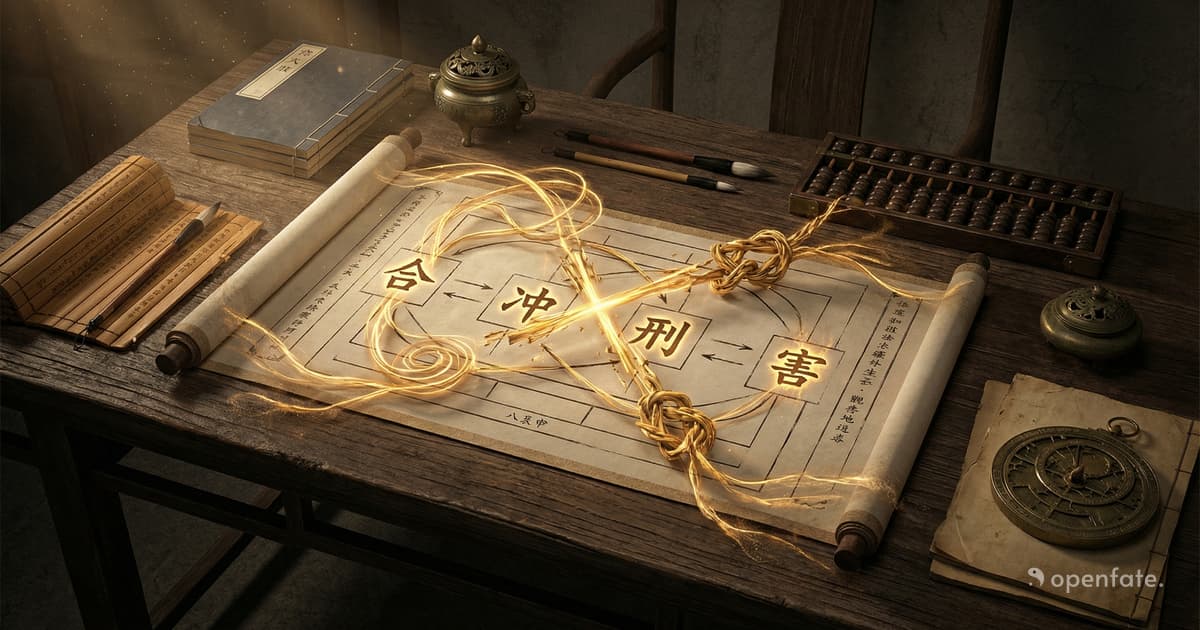
Combinations, Clashes, Punishments, and Harms are dynamic structural signals exposing exact areas of relationship tension, career friction, internal drains, and major shifts. They are not absolute curses, as highlighted by the classic San Ming Tong Hui: "Clashes, punishments, and harms... may originally imply misfortune, but if powerfully rescued by combinations, reverse into auspiciousness."
Introduction
These questions are normal. But reducing these concepts to simple labels distorts the reading. In real Bazi, they do not judge morality or assign lucky/unlucky tags. They tell you how the forces inside your chart interact.
The real question is how these structures make your relationships, marriage, career, and life rhythm stickier, more unstable, more strained, or more draining.
What Does He Chong Xing Hai Mean in Bazi?
The simplest explanation is: He, Chong, Xing, and Hai are interaction patterns between stems and branches in the chart.
They are not just symbolic labels. They show whether forces attract each other, collide, constrain each other, or create hidden wear.
They are the interaction language of structure, explaining why the chart behaves the way it does.
Why Shouldn’t They Be Reduced to Good or Bad?
Because they describe modes of interaction, not moral verdicts. Combination is not always good (it can be sticky entanglement). Clash is not always bad (it can mean movement or breakthrough). Punishment is not always disaster (it often means long-term inner friction).
If all someone knows is "combination good, clash bad", the reading stays very shallow.
He Chong Xing Hai describes interaction mechanics rather than simple dualistic judgments.
What Does “He” (Combination) Feel Like?
The simplest explanation: He feels like being pulled together. It suggests binding, attraction, entanglement, sticking, and difficulty separating.
The key point of He is not "good", but: hard to loosen.
It is not always sweetness. It may appear as relationships becoming too sticky, blurred boundaries, unresolved emotions, or cooperative dragging.
What Does “Chong” (Clash) Feel Like?
Chong feels like collision and activation. It suggests change, movement, instability, triggering, and one force hitting another into motion.
The key point of Chong is not "ruin", but: hard to keep still.
It often shows up as a theme that refuses to stay still, a life rhythm experiencing waves (like moving or job changes), or stillness being broken open for a new breakthrough.
What Does “Xing” (Punishment) Feel Like?
Xing feels like grinding, tightening, and being internally twisted. It is long-term awkwardness, slow pressure, and persistent unsmoothness.
The key point of Xing is not "disaster", but: long-term unsmoothness.
In real life, it appears as relationships that are always a bit twisted, work that keeps hitting invisible resistance, or accumulated strain rather than one big explosion.
What Does “Hai” (Harm) Feel Like?
Hai feels like hidden damage, subtle misfit, or quiet drain. It shows up as misunderstanding, distance, silent wear, and low-grade but ongoing imbalance.
The key point of Hai is not "conspiracy", but: hidden attrition.
Nothing openly breaks, but it never feels right. Small friction accumulates into deep tiredness—it is the dull knife that slowly wears you down.
Why Do Many People Not Have “Bad Relationships,” but Structures That Pull More Easily?
Many relationships are not loveless. They are simply not clean-flowing—they are full of repeated tension or constantly slightly tangled.
Relationships carrying strong combinations, clashes, punishments, or harms easily stick, collide, grind, or wear quietly. This isn't about a lack of feeling; it's about structures that cost energy to hold.
It is not always "no love". Often, it is a relationship that naturally costs more energy to maintain.
Why Does He Chong Xing Hai Affect Marriage?
Marriage is vulnerable to overbinding, overmovement, long-term friction, and hidden drain—exactly what He, Chong, Xing, and Hai describe.
Too much He blurs boundaries. Strong Chong makes the relationship seat move. Strong Xing makes marriage heavy over time. Deep Hai creates quiet misunderstanding. Marriage fears structural drain more than a lack of love.
Why Does This Affect Career and Work?
Career is a structural system. You might struggle at work not because you lack ability, but because He causes collaborative dragging, Chong causes role changes, Xing blocks your process, or Hai introduces hidden friction.
The felt experience becomes not a lack of ability, but an incredibly high process cost to get things done.
Why Do Luck Pillars Change the Felt Experience?
Many structures exist quietly until Luck Pillars or annual timing activate them. They become illuminated, amplified, and broken open into lived experience.
The natal chart gives the structure, and timing gives the felt experience.
4 Examples Users Can Understand Easily
Not bad, but exhausting: Relationships with tight He, twisting Xing, or draining Hai are hard to separate from but always heavy. This is not lack of feeling, but high structural drain.
Marriage moved by external events: A clashed Spouse Palace means work or housing changes disturb the marriage bond. The issue is a long-term seat that struggles to stay still.
Collaboration turning painful: Starts with He but develops Xing or Hai. Boundaries blur, progress slows, and discomfort grows. The structure has weak long-term stamina.
Periods of sudden twists: When certain Luck Pillars arrive, background tension amplifies into real-world strain. Fate did not suddenly change; the structure was activated.
The 5 Questions Users Should Remember
Question 1: Does this structure feel more like sticking, colliding, grinding, or hidden drain?
Question 2: Where in the chart does it land? (Marriage, family, work, etc.)
Question 3: Is it a temporary trigger or a long-term background pattern?
Question 4: Is the issue "bad relationship", or a structure that naturally pulls harder?
Question 5: When do my Luck Pillars most strongly activate this structure?
The 8 Most Common Beginner Mistakes
Mistake 1: Assuming He always means good. It can just mean sticky entanglement.
Mistake 2: Assuming Chong always means bad. It can mean breakthrough or restructuring.
Mistake 3: Assuming Xing always means disaster. It usually just means long-term friction.
Mistake 4: Assuming Hai always means petty people. It often means quiet misunderstanding.
Mistake 5: Reading one interaction without seeing where it lands, keeping it abstract.
Mistake 6: Reading only the natal chart and ignoring annual timing triggers.
Mistake 7: Blaming all relational pain on people rather than recognizing the difficult structure.
Mistake 8: Treating these as fixed dualistic labels instead of interaction mechanisms.
Most Practical Takeaways
Not simple labels: He Chong Xing Hai are not good or bad tags, but modes of how chart forces interact.
Four patterns: He feels like sticking, Chong like movement, Xing like grinding, and Hai like hidden wear.
The truth about tension: Many people do not have "bad relationships" — they have structures that naturally pull harder.
Placement matters: Where these interactions land determines if they affect marriage, work, or inner life.
Timing dictates intensity: The chart provides the structure, and Luck Pillars provide the activation stage.
Explore Related Concepts
FAQ
What is the safest way to read He Chong Xing Hai?
Identify which characters interact, where they land, and whether they are sticking, colliding, grinding, or draining, and then check Luck Pillars for timing activation.
Is Combination (He) always good?
No. He feels like being pulled together. It can foster harmony, but it can also mean sticky entanglement and unclear boundaries.
Is Clash (Chong) always bad?
Not necessarily. Clash means movement and triggering. It causes instability but can also force necessary breakthrough, relocation, or restructuring.
What is the difference between Punishment and Harm?
Punishment (Xing) is more like long-term grinding and persistent unsmoothness. Harm (Hai) is more like quiet drain, hidden misunderstanding, and slow wear.
Do these interactions affect marriage and career?
Yes, very frequently. When they land on relational or career seats, you will experience their pulling, movement, friction, or drain in those specific areas of life.
Want to Know What Is Pulling You in Your Chart?
Start with an accurate Bazi chart and see where combinations, clashes, punishments, and harms are structurally placed in your life path.
 Check Your Structural Tension
Disclaimer: Metaphysics is a traditional cultural perspective, not a substitute for modern science. Content is for reference only; please exercise rational judgment based on your specific situation.