Bazi AcademyReading Guide
How to Read a Bazi Chart? A Beginner's Step-by-Step Guide
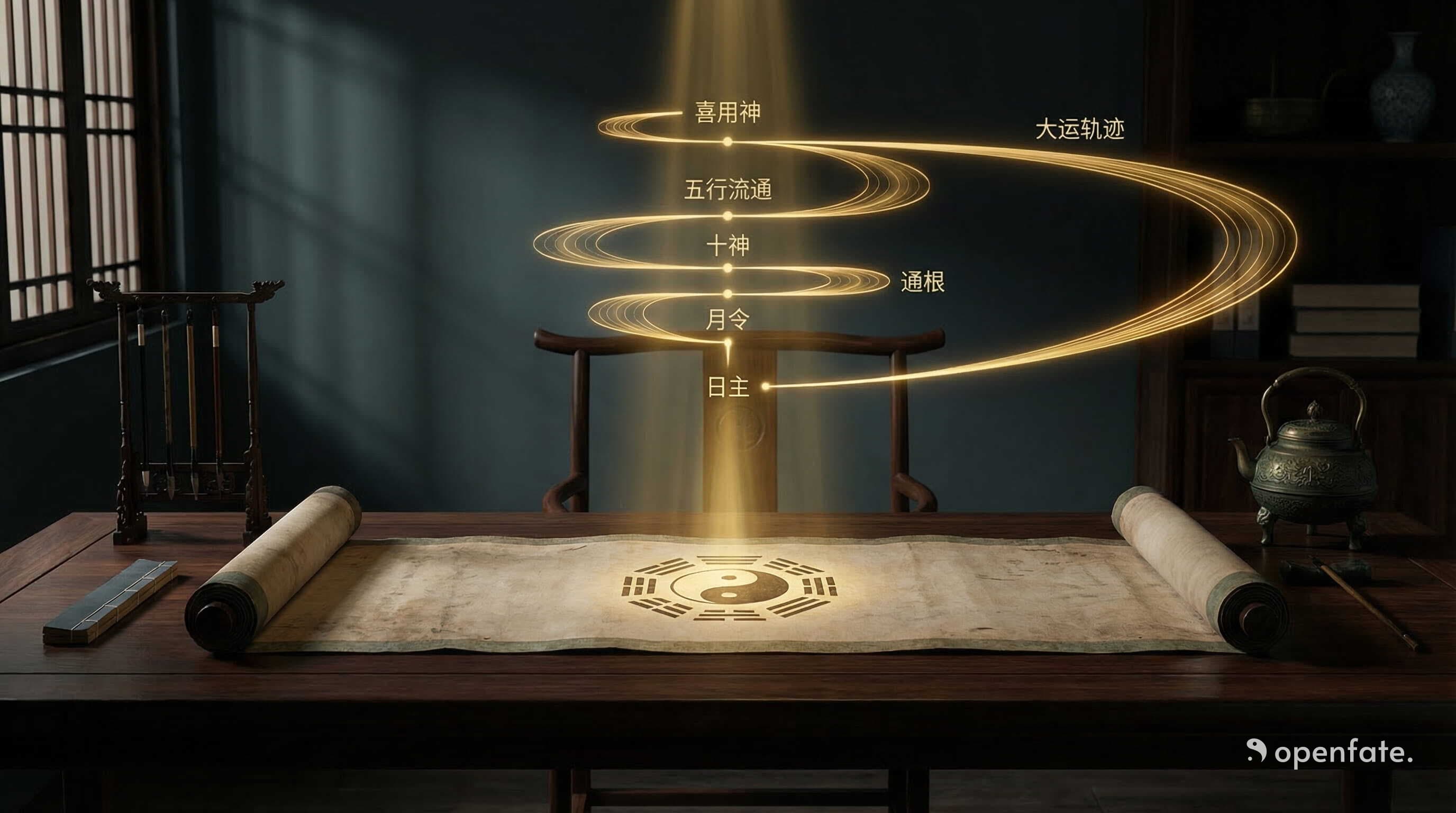
Introduction
Identify the Day Master\'s strength first, establish the chart structure via the Month branch, and verify Luck Pillars for life trajectory. As Zi Ping Zhen Quan states, the Useful God dictates fortune; reading a chart means decoding the systematic flow of these energy variables.
The first time you see a Bazi chart, the amount of data can be overwhelming. You see stems, branches, gods, and luck cycles but don't know where to start.
Randomly picking keywords like "Wealth" or "Peach Blossom" often leads to missing the main theme of the chart.
Reading a chart correctly requires a structured sequence: Core identity first, then environment, then support.
What Are You Actually Looking At?
A Bazi chart converts your birth time into Four Pillars to show your elemental energy distribution.
The goal of reading is to synthesize these fragmented pieces into a coherent understanding of your structural tendencies and life themes.
Mistake #1: Starting With "What Am I Missing?"
Many beginners immediately ask "Am I missing Wood?" or "Do I need Fire?" While quantity matters, it is not the first step.
Bazi analysis isn't simple addition. Without understanding the structure first, adding a "missing" element might actually cause more imbalance.
Step 1: The Day Master (The Core)
The Day Master is the stem of the day of birth, representing "You."
Only by identifying the self-element can you meaningful judge what supports you, pressures you, or depletes you.
Step 2: The Month Branch (The Environment)
The Month Branch represents the seasonal climate you were born into.
It determines which elements have historical momentum. Being supported by the Month Branch is a major structural advantage.
Step 3: Roots and Support (The Foundation)
Check if the Day Master has "roots" in the Earthly Branches.
Visible stems are surface traits. Deeper roots in the branches determine long-term resilience and stability.
Step 4: Ten Gods Structure (The Operating Mode)
Identify which relationship pattern dominates your life framework.
Are you driven by competition (Companions), creativity (Output), or responsibility (Authority)? Understanding the mode reveals your core drivers.
Step 5: Elemental Flow (System Smoothness)
How elements convert into one another is often more important than raw count.
A smooth flow ensures energy doesn't get "stuck" in one sector, leading to a more functional life pattern.
Step 6: Judge Chart Strength
Synthesize the previous five layers to judge if the Day Master is structurally strong or weak.
This isn't about character strength but rather the elemental capacity to carry or receive energy.
Step 7: Identify Favorable Elements
Favorable elements are the "prescription" for the chart's imbalance.
This can only be identified after the previous six steps have highlighted where the structural blocks are.
Step 8: Luck Pillars and Annual Triggers
The chart is the car; luck cycles are the road. Triggers decide *when* natal potential is activated.
Auxiliary stars like Nobleman or Peach Blossom belong here as supplemental details.
Summary of the Sequence
Read the framework first, then the timing. Read the skeleton first, then the labels. Follow these 8 steps for a stable reading.
Precision Starts With Data
Accurate time, time zones, solar terms, and True Solar Time are non-negotiable for a professional reading.
Only when the chart data is precise does the reading methodology become truly meaningful.
Deepen Your Bazi Knowledge
FAQ
Where do I start reading my chart?
Start with the Day Master. It is the central reference point for the entire analysis.
Should I worry about missing elements?
Not until you've read the structure. Sometimes a missing element is actually beneficial to stay away from.
Why does the month matter so much?
The month determines the seasonal strength of elements, often accounting for a huge portion of the chart's behavior.
Ready to Read Your Chart Correctly?
Bazi is a structural science, not a guessing game. Get an accurate chart and follow the scientific sequence.
 Read My Chart Step-by-Step
Disclaimer: Metaphysics is a traditional cultural perspective, not a substitute for modern science. Content is for reference only; please exercise rational judgment based on your specific situation.