Personality TestBZTI
What Is BZTI? A Birth-Based Factory Settings Card
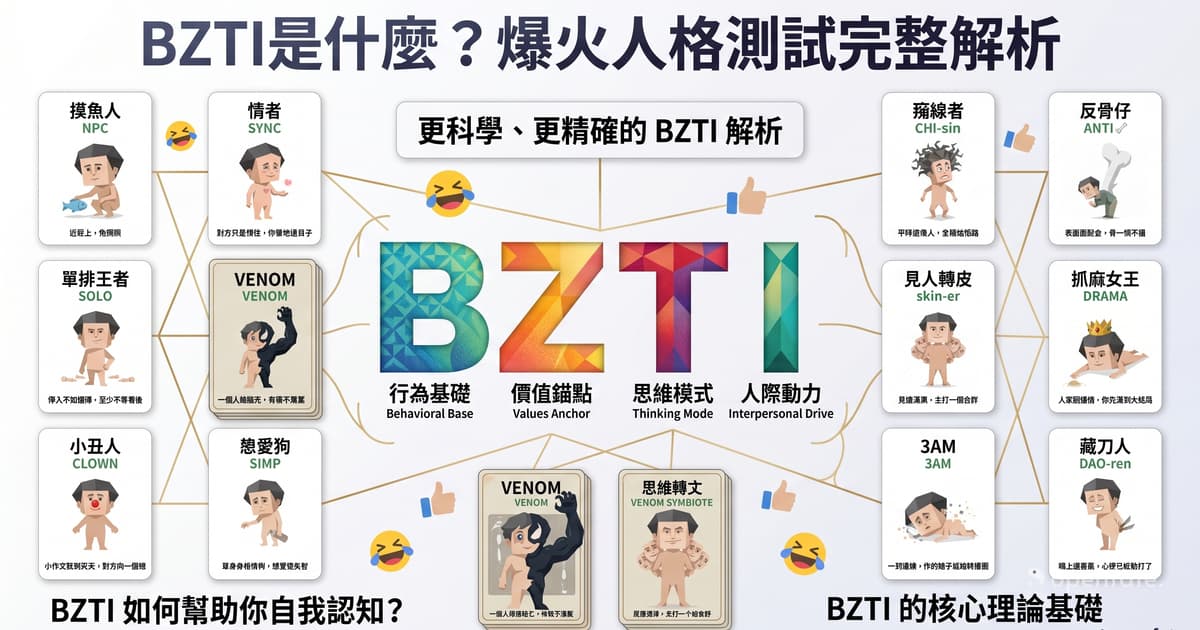
Core Answer
BZTI is a birth-based status card system that skips the usual quiz flow and directly translates structured birth data into one of 32 shareable personality codes. It combines a fixed matching engine with highly social, screenshot-friendly labels designed to feel more product-native than traditional personality tests.
Introduction
If MBTI was the older language of personality and SBTI was the meme-native social label, BZTI is better understood as the next step: a factory settings status card. It does not ask users to answer a long quiz. Instead, it turns a line of birth data into a shareable result card that feels like a personal runtime label.
By the current code-level definition, BZTI has 32 public types: 19 base types, 7 dynamic states, and 6 SSR hidden types. The product goal is not to sound academic. It is to tell you, quickly and memorably, what kind of cyber-state your life pattern resembles most.
BZTI is not a questionnaire-first personality test. It is a birth-data-to-status-card product.
Why does BZTI make sense right now?
Because modern personality content is no longer judged only by whether it sounds deep. It is judged by whether people can understand it instantly, repost it instantly, and use it as a social language. MBTI often feels too formal and over-familiar. SBTI is highly shareable, but many of its labels work more like emotional jokes than like a structured universe.
BZTI sits in the middle on purpose. It keeps the immediate social readability that made SBTI spread, but it anchors the result in a more consistent system. That makes the output feel less like a random roast and more like a product with a real internal logic.
How does BZTI generate a result?
At the user level, the flow is simple: enter birth date, time, city, and gender, then wait for the card. Under the hood, BZTI is not a quiz. It is a deterministic chain: validate the birth data, compute the structural chart signals, match those signals to a fixed type universe, and then render the result as a shareable card.
That is why the experience feels light while the system still feels coherent. The user does not have to study any metaphysical framework to use it, but the result is still generated through a stable pipeline rather than pure improvisation.
How is BZTI different from MBTI and SBTI?
MBTI asks how you describe yourself and maps that onto a 16-type framework. SBTI asks similar inputs, then translates them into meme-like internet archetypes. BZTI skips the self-description stage and starts from birth data instead. In product terms, it feels less like a personality survey and more like reading your factory settings directly.
That difference changes the whole experience. MBTI is best for long-form self-description. SBTI is best for quick social jokes. BZTI is best when the result itself is the product: a name, a code, a status line, and a card you can immediately screenshot and share.
What exists inside the current BZTI universe?
Public types: 32
Base types: 19, representing stable long-term operating patterns
Dynamic types: 7, representing scene-triggered runtime states
SSR types: 6, representing the rarest hidden cards in the system
The result is framed less as a job-safe personality label and more as a cyber-style status code
Why is BZTI naturally shareable?
Because it behaves more like social currency than like a report. A strong BZTI result page leads with a type name, a code, a single sharp status line, and a result card image. That format is built for group chats, reposts, stories, comments, and friend-to-friend identity projection.
Just as important, BZTI changes the language of personality. Instead of speaking in abstract theory, it borrows from operating systems, status bars, runtime modes, and error-code culture. That makes it feel much closer to how younger users already talk online.
Final takeaway
The real value of BZTI is not academic depth for its own sake. Its value is that it turns personality output into a product system people can run, recognize, and share. It borrows structure from older frameworks and social sharpness from meme-native formats, then pushes both into a more productized direction.
If MBTI is a classic framework and SBTI is a viral label game, BZTI is what happens when the result itself becomes a designed social object.
Related Reading
FAQ
What is BZTI?
BZTI is a birth-based personality status card system with 32 public result types in its current universe.
Does BZTI use quiz questions?
No. BZTI is designed as a birth-data-driven result flow rather than a questionnaire-first test.
How is BZTI different from SBTI and MBTI?
MBTI is a classic personality framework, SBTI is a meme-native test, and BZTI is positioned as a direct factory-settings status card product.
How many BZTI types are there right now?
By the current code definition, BZTI has 32 public types, including 6 SSR hidden types.
Generate your BZTI factory settings card
Enter one line of birth data and let the system turn it into a shareable status card.
 Generate My BZTI
Disclaimer: Metaphysics is a traditional cultural perspective, not a substitute for modern science. Content is for reference only; please exercise rational judgment based on your specific situation.