Personality TestBZTI Comparison
BZTI vs SBTI vs MBTI: Which personality language feels most native to now?
Core Answer
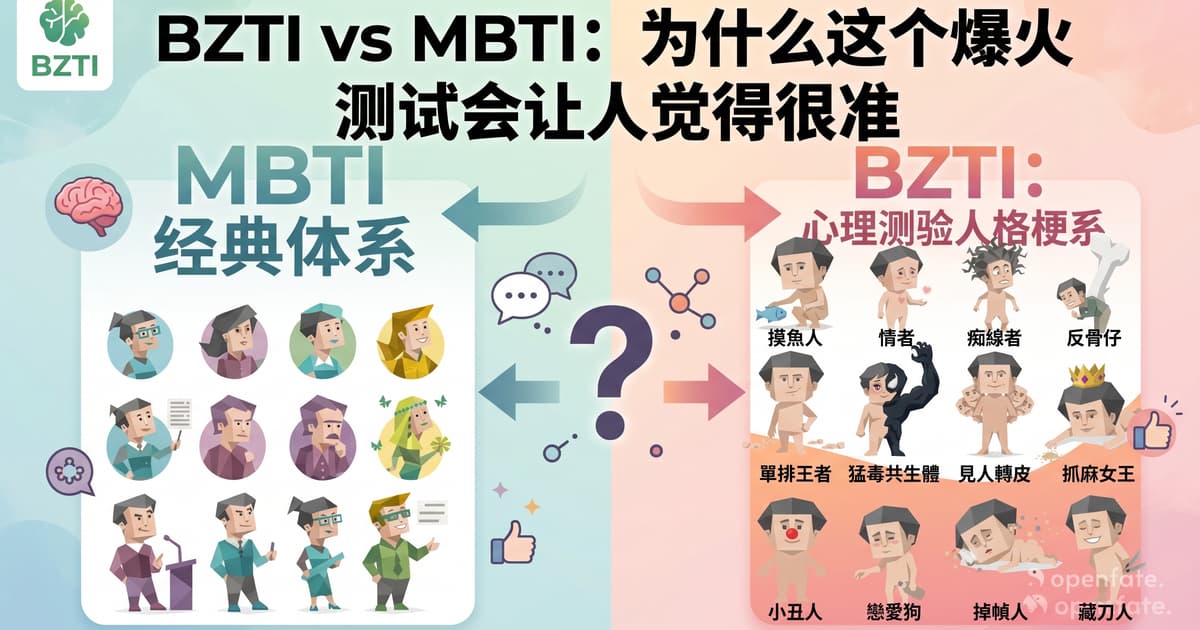
MBTI works as a classic long-term personality framework, SBTI works as a meme-native emotional label test, and BZTI works as a birth-data-driven factory settings card. They are not direct replacements for one another, but three different answers to how people want personality results to function today.
Introduction
MBTI, SBTI, and BZTI all try to do the same thing at a high level: give people a label they can recognize themselves in quickly. But the language each system uses is completely different. MBTI behaves like a classic personality framework, SBTI behaves like an internet-native meme test, and BZTI behaves like a shareable product card.
So the real question is not which one is more scientific. The real question is which one best fits how personality content works now, where recognition, repostability, and social identity all matter at once.
The three systems at a glance
BZTI
Core format:Birth-data status card
Number of results:32 types
Input style:Birth date, time, city, gender
Strongest trait:Feels like a product and a code card
Best use case:Instant result card and sharing
SBTI
Core format:Meme-native personality test
Number of results:27 types
Input style:Prompt-style quiz
Strongest trait:Feels like a joke label and social roast
Best use case:Fast social resonance and memes
MBTI
Core format:Preference-based personality framework
Number of results:16 types
Input style:Preference quiz
Strongest trait:Feels like a framework and stable self-description
Best use case:Long-term self-description and personality discussion
MBTI: classic, but now very familiar
MBTI still offers something real: structure, stability, and a vocabulary that almost everyone already recognizes. Once you say INTJ or ENFP, most people understand that you are referencing a known framework rather than a trend cycle.
But that same familiarity is also its limit. For many younger users, MBTI now feels fully absorbed into corporate workshops, social templates, and overused self-intros. It still has explanatory power, but not always novelty.
SBTI: the group-chat label of the meme era
SBTI became viral not because it was more rigorous, but because it sounded more like how people actually talk online. It turned personality results into social roasts, inside jokes, and emotional shorthand. The result often feels less like a diagnosis and more like a friend calling you out accurately.
That makes SBTI perfect for screenshots and reposts. But it also means many labels land through emotional recognition more than through deep structure. The system is powerful as social language, even when it is looser as a long-term framework.
BZTI: personality results as a product, not just a label
BZTI starts from a different place. Instead of asking users to answer a personality quiz, it asks for birth data and returns a ready-made result card. It keeps the social sharpness that made SBTI spread, but tries to package the outcome through a more fixed internal matching structure.
That is why BZTI feels different. It is not just a new set of labels. It is a redesign of the personality-result experience itself, where the output behaves like a product card: name, code, line, image, shareability.
Why BZTI feels more native to this moment
Because today, personality content is shifting from “who am I forever?” to “what does my current operating state look like?” Users do not always want a permanent four-letter identity, and they do not always want a joke that burns out in three days either. They want something that can feel structured and still travel socially.
That is where BZTI fits. It does not ask users to learn theory first. It does not ask them to buy into maximum seriousness. It only asks them to feel that the card really looks like them, and in product terms that is often enough.
Final conclusion
MBTI still works best as a stable personality framework. SBTI still works best as a meme-native social test. BZTI works best when the result itself needs to feel like a designed, shareable object.
Use MBTI for long-term self-description. Use SBTI for internet-era mood resonance. Use BZTI when what you really want is a one-click, screenshot-ready factory settings card.
Related Reading
FAQ
What is the biggest difference between BZTI, SBTI, and MBTI?
MBTI is a classic framework, SBTI is a meme-native social test, and BZTI is a birth-data status card product.
Will BZTI replace MBTI?
Not necessarily. They solve different use cases: MBTI for long-term structure, SBTI for viral emotional labeling, and BZTI for shareable productized results.
Why is SBTI easier to spread than MBTI?
Because it sounds more like internet language, with shorter and sharper labels that travel well as screenshots and jokes.
Why does BZTI feel more like a product?
Because it skips the long quiz experience and returns a finished result card that behaves like a feature, not just a label.
Generate your BZTI result card
If the differences are clear now, the next step is not more theory. It is seeing your own card.
 Generate My BZTI
Disclaimer: Metaphysics is a traditional cultural perspective, not a substitute for modern science. Content is for reference only; please exercise rational judgment based on your specific situation.