Bazi AcademyTai Yuan & Ming Gong
Tai Yuan, Ming Gong, Shen Gong: The Three Hidden Pillars of Lu Ming
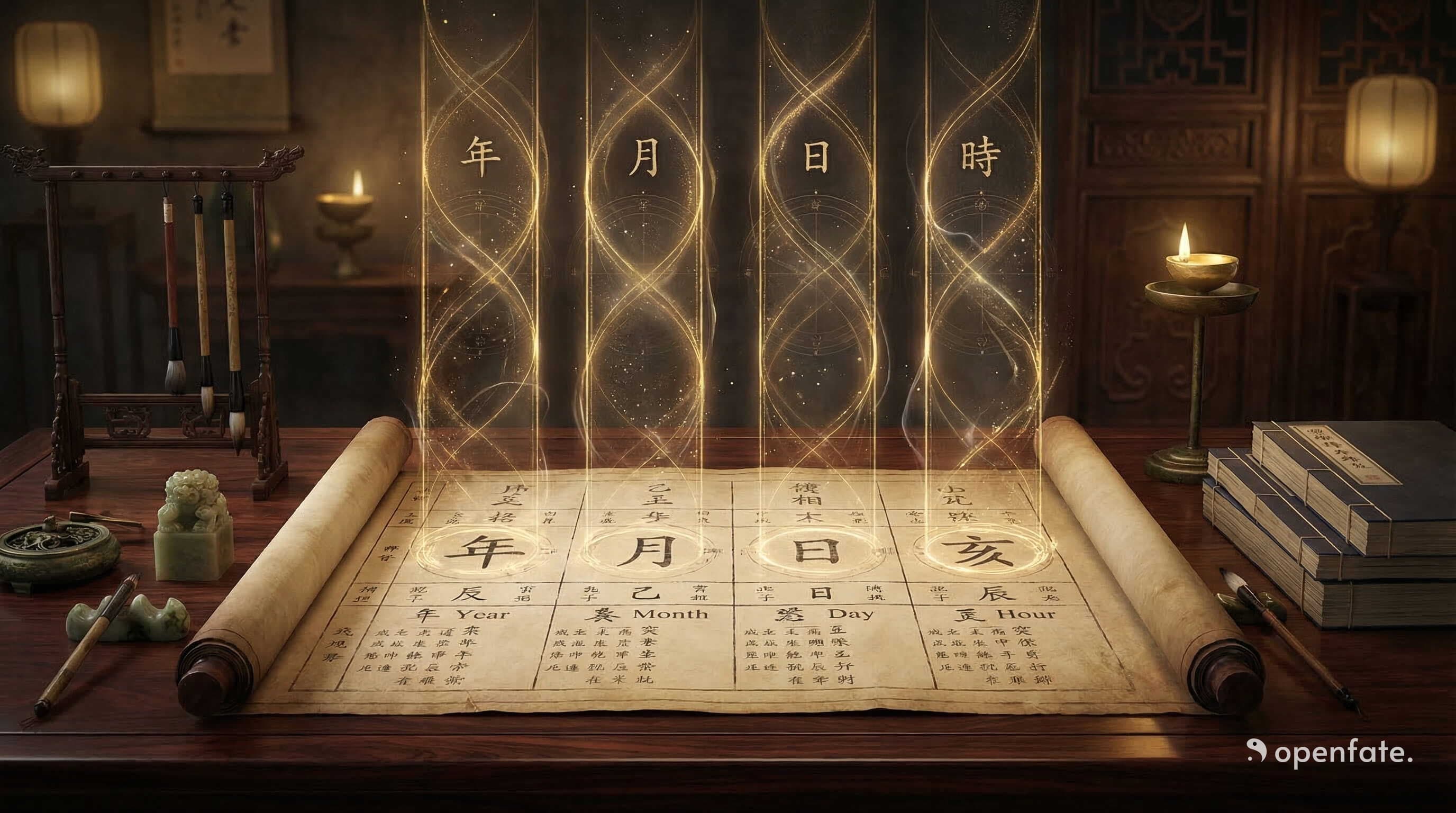
Core Answer
Tai Yuan, Ming Gong, and Shen Gong are the three hidden pillars ancient Lu Ming adds beyond the four: Tai Yuan derives the conception month and governs innate foundation; Ming Gong, set from the birth month and hour, is called the fifth pillar and governs lifelong structure; Shen Gong pairs with it for later-life placement. Per the Sanming Tonghui and Yuanhai Ziping, they are supplementary coordinates, never sole judges.
Introduction
Many people learn Bazi and cast only the four pillars, reading just eight characters, assuming that once year, month, day, and hour are in place the chart is complete. Yet open a Lu Ming text and you find three "hidden pillars" standing beyond the four: Tai Yuan, Ming Gong, and Shen Gong.
Each hidden pillar has its own job. Tai Yuan fills in the innate information present at the moment of conception; Ming Gong fills in the base tone of your lifelong structure; Shen Gong fills in where your middle and later years actually come to rest. They are not written in the eight characters, yet the ancients treated them as indispensable coordinates.
Reading only the four pillars means dropping the three rulers ancient method uses to see foundation, parents, and later life. Understanding Tai Yuan, Ming Gong, and Shen Gong is how you read a chart back from "eight characters" into the full coordinate system of Lu Ming.
Where the Three Hidden Pillars Come From: Method and Meaning
Tai Yuan is the stem-and-branch of the conception month, derived from the Month Pillar: advance the stem by one and the branch by three, and you have the Tai Yuan (see the Sanming Tonghui, "On Tai Yuan"). It represents the innate source of conception and governs constitution, heredity, and foundation.
Ming Gong, the "palace where destiny is settled," is set by pairing the birth month and hour. Classical method establishes the palace from solar terms and month-generals (the Yuanhai Ziping records it), and Ming Gong governs the base tone of lifelong structure and fortune — long called the "fifth pillar" beyond the four.
Shen Gong is set in coordination with Ming Gong, the two mirroring each other: Ming Gong governs the base of innate structure, while Shen Gong governs the actual home and landing of the middle and later years. To judge whether a person's later life has support, ancient method returns to Shen Gong for confirmation.
Tai Yuan, Ming Gong, Shen Gong: Four Key Points
Tai Yuan — Source of Conception
Derived by advancing the Month stem by one and branch by three; governs innate foundation, parental heredity, and constitution — the "origin" before the four pillars.Ming Gong — Palace of Destiny
Set from the birth month and hour; governs lifelong structure and the base tone of fortune, long regarded as the "fifth pillar" beyond the four.Shen Gong — Palace of the Body
Set in coordination with Ming Gong; governs the actual home and landing of the middle and later years — later life is confirmed at Shen Gong.Relation to the Four Pillars
The three hidden pillars are supplementary coordinates to the four pillars — read alongside them, never used alone to fix a destiny.
Visible and Hidden Pillars in One Sentence
The Four Pillars: The Main Arena of Life
Year, month, day, and hour are the visible information and the main body of judgment. Balance, structure, and annual luck are drawn mainly from these eight characters.The Hidden Pillars: Life's Background Coordinates
Tai Yuan, Ming Gong, and Shen Gong are background and foundation coordinates, filling in the innate origin and later-life landing the four pillars cannot show — complete only when read together.
How to Cast the Three Hidden Pillars, Step by Step
The hidden pillars are not mystical talk; each has a clear method. Follow these three steps and you can add Tai Yuan, Ming Gong, and Shen Gong beyond the four pillars, then read foundation and later life from them:
Cast Tai Yuan: take the Month Pillar, advance the stem by one position and the branch by three; the resulting stem-and-branch is the Tai Yuan, representing the innate source of conception.
Cast Ming Gong: first fix the birth month and hour, then settle destiny in its corresponding palace by the solar-term and month-general method; the Ming Gong stem-and-branch is the base tone of lifelong structure.
Read the hidden pillars: a Tai Yuan met with support means a solid foundation, one met with clash means early-life turbulence; a well-placed Ming Gong means structure with support, and a rooted Shen Gong means a secure later life.
What the Hidden Pillars Fill In: Three Distinct Uses
The four pillars excel at personal balance and annual luck, but have a few natural blind spots — precisely what Tai Yuan, Ming Gong, and Shen Gong fill in. They carry distinct value on the following three questions:
Parents and innate foundation: Tai Yuan governs the source of conception, filling in heredity, constitution, and parental foundation that the four pillars struggle to show directly.
Later-life placement: Shen Gong governs the landing of the body, and to judge whether later life is stable and supported, ancient method confirms it at Shen Gong.
Cross-checking the birth hour: when the birth hour is uncertain, Ming Gong serves as an extra anchor, cross-verifying against the four pillars to narrow the margin of error.
Two Cautions When Using the Hidden Pillars
First, methods for casting Ming Gong differ by school: some set the palace from the birth month, others from the month-general or solar terms, and the palaces they settle need not match — always state which method you use, or the result cannot be rechecked. Though named "source of conception," Tai Yuan is a symbolic stem-and-branch coordinate, not a precise medical gestational age, so do not over-literalize it into an actual month of conception.
Second, keep the relation to Zi Ping straight: modern Zi Ping mostly omits Ming Gong and Shen Gong or treats them only as reference, whereas Lu Ming weighs them heavily. The safest stance is to treat Tai Yuan, Ming Gong, and Shen Gong as supplementary coordinates to the four pillars, read together with the eight characters, and never draw a conclusion from Ming Gong alone. The three hidden pillars are rulers of background and foundation, not a second destiny that replaces the four pillars.
Ancient Lu Ming Series · Further Reading
FAQ
How is Tai Yuan calculated?
Ancient method takes the Month Pillar: advance the stem by one position and the branch by three, and the resulting stem-and-branch is the Tai Yuan (see the Sanming Tonghui, "On Tai Yuan"). It represents the innate source of conception, governing foundation, constitution, and parental heredity — the "origin" before the four pillars.
Is Ming Gong really the fifth pillar?
It is often called that. Ming Gong is set from the birth month and hour and governs lifelong structure and the base tone of fortune, so ancient method treats it as an important coordinate beyond the four pillars, hence the "fifth pillar." But it is a supplementary coordinate — read alongside, never used alone to fix a destiny.
What is the difference between Shen Gong and Ming Gong?
Ming Gong governs the base of innate structure, the starting point of lifelong pattern; Shen Gong is set in coordination with it and governs the actual home and landing of the middle and later years. In short, Ming Gong shows the "base," Shen Gong shows "where later life lands" — the two mirror each other.
Can I still use Ming Gong if I don't know the exact birth hour?
Yes, but with caution. Ming Gong is set from the birth hour, so an uncertain hour makes the result shift. In that case, use Ming Gong as one cross-checking anchor, verifying against the four pillars and Tai Yuan to narrow the hour range, rather than judging from Ming Gong alone.
Want to see the Tai Yuan, Ming Gong, and Shen Gong beyond your four pillars?
Start by casting an accurate Bazi chart. We give you a clear, personalized Day-Master reading while keeping the door open to Tai Yuan, Ming Gong, Shen Gong, and other classical hidden-pillar lenses.
 Cast My Chart
Disclaimer: Metaphysics is a traditional cultural perspective, not a substitute for modern science. Content is for reference only; please exercise rational judgment based on your specific situation.