Bazi AcademyNa Yin Three Sources
Na Yin Three-Tier Analysis: How Lu Ming Reads a Chart From the Year and Na Yin
Core Answer
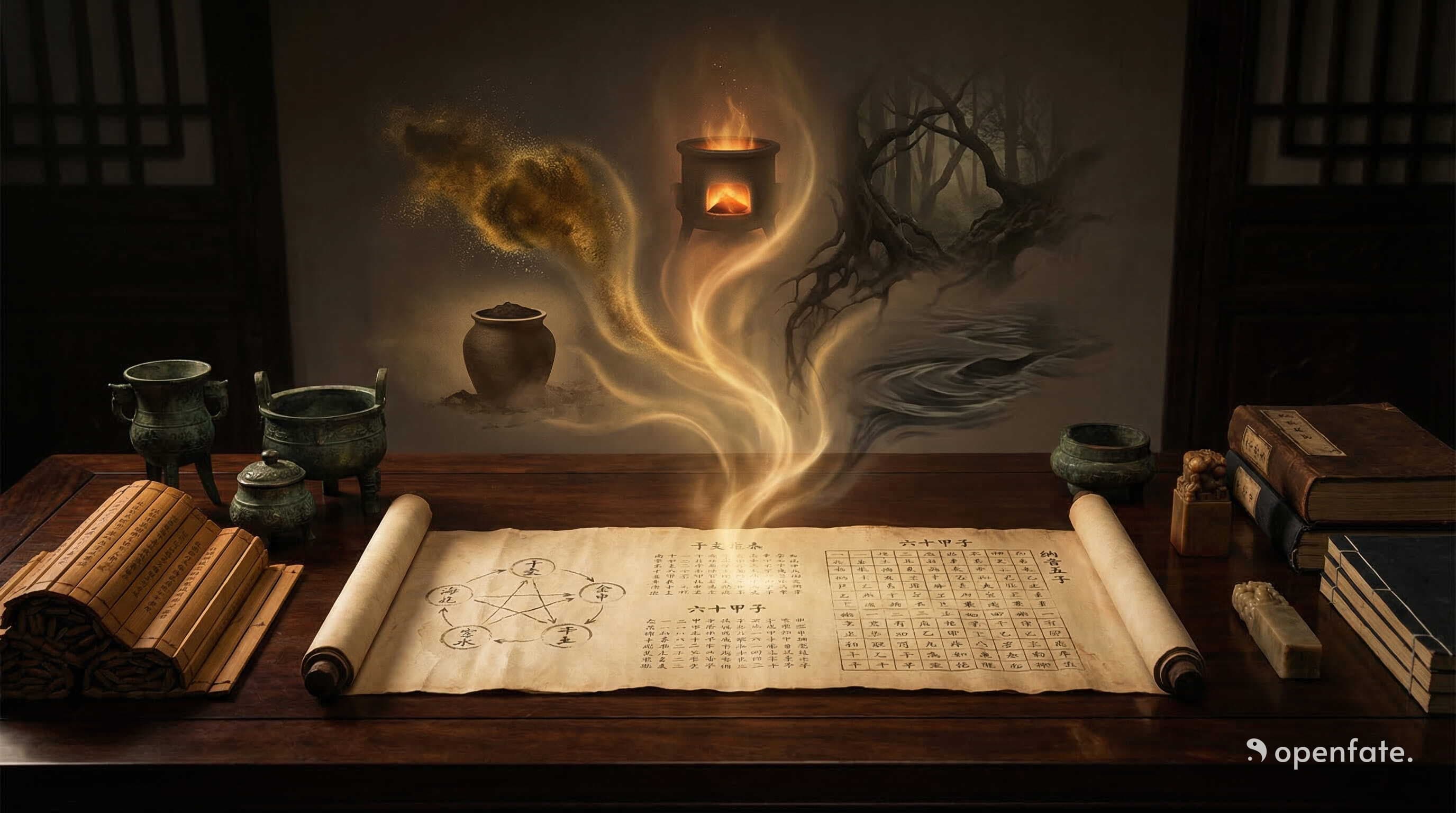
Na Yin three-tier analysis is the skeleton of Lu Ming reading: first take the Year Pillar Na Yin as the whole-life image, then split each pillar into Heaven (stem), Earth (branch), and Human (hidden stem) tiers. As the Yuanhai Ziping notes on the three sources, each governs its own domain — Na Yin frames the image while the three tiers reveal the structure.
Introduction
Anyone who has studied Bazi knows the two familiar layers of a pillar: the Heavenly Stem on top and the Earthly Branch below, two characters in all. But open a Lu Ming text and you find the same pillar split into three layers instead — and that is exactly where most readers first get lost in the classics.
Those three layers are what Lu Ming calls the "three sources": Heaven, Earth, and Human. Above them, Lu Ming lets the Year Pillar Na Yin govern the whole chart — you read the Na Yin image of the pillar first, then descend into the three sources. This is the method of Na Yin three-tier analysis.
Grasping the three sources is the first threshold to reading Lu Ming. It is both the skeleton of the system and one of the sharpest points on which Lu Ming and Zi Ping differ in how they read a single pillar.
Where the Three Sources Come From: Heaven, Earth, and Human Defined
The doctrine of "three sources" comes from Tang and Song texts, which split a pillar of stem and branch into three layers. The Heaven source is the Heavenly Stem, the Earth source is the Earthly Branch, and the Human source is the stem hidden inside the branch — the very stem the "Human source in command" points to as the one truly on duty and in charge.
The Yuanhai Ziping chapter on Heaven, Earth, and Human, and the Wuxing Jingji, both treat the three sources systematically: Heaven governs the outward and the visible, Earth governs foundation and environment, and Human governs hidden force — the commanding god that actually acts within the pillar. Each source has its own domain, and only together do they give a pillar its full information.
Lu Ming adds one layer above the three sources: the Year Pillar Na Yin as the "root of body and destiny." Reading a Lu Ming chart, the classical order is to take the Year Pillar Na Yin image first, setting the atmospheric keynote of a whole life, then descend pillar by pillar into the three sources — "Na Yin frames the image, the three tiers reveal the layers."
Four Layers in One Pillar: Heaven, Earth, Human, and Na Yin
Heaven source (Stem)
Outward and visible — the surface and standing of the pillar. It is the pillar's "public face," how it presents itself to the world.Earth source (Branch)
Inward and foundational — the environment and background the pillar stands on. It is where the stem plants its feet, deciding whether the stem has a root.Human source (Hidden stem)
The stem hidden inside the branch, governing latent force. The one in season and on duty is the "Human source in command" — the force that truly runs the pillar.Na Yin (Great image)
The imagery that governs a pillar's Five Elements, an overall atmosphere above stem and branch. The Year Pillar Na Yin is especially the root of destiny, setting a life's keynote image.
One Vertical, One Horizontal: Three Tiers and the Na Yin Image
Three Tiers: Seeing One Pillar as Three Layers
Three-tier analysis is the micro, vertical dimension: within one pillar you read Heaven, Earth, and Human layer by layer, from surface to foundation to the hidden commanding force. It answers "what is the internal structure of this pillar, and who is truly in charge."Na Yin Image: Seeing a Whole Life as One Breath
The Na Yin image is the macro, horizontal dimension: the Year Pillar Na Yin governs the whole, reading a life as the unfolding of one great breath — judging the clarity, thickness, and rhythm of its atmosphere. It answers "what is the grand shape and keynote of this whole life."
The Reading Order of Na Yin Three-Tier Analysis
In Lu Ming, Na Yin and the three sources are not drawn at random but in a fixed order. These four steps are the standard reading of Na Yin three-tier analysis:
First fix the Year Pillar Na Yin and take the whole-life image: see which element it belongs to and whether it is clear or muddy, thick or thin, setting the atmospheric keynote of a life.
Split every pillar into Heaven, Earth, and Human: break year, month, day, and hour each into the three tiers, seeing the surface, foundation, and hidden force of every pillar.
Find the Human source in command and fix the true acting god: locate the hidden stem in season and on duty — that is the force truly in charge and truly grounded in the pillar.
Cross-read the three tiers under the Na Yin image: judge the making or breaking of the structure and the rise-and-fall rhythm of a life by the generation-control among the tiers together with the Na Yin image.
What Na Yin Three-Tier Analysis Does Best
Three-tier analysis is not a short-range tool for judging "will next month go smoothly." Its strength lies in macro questions of foundation, environment, and the whole-life image:
Foundation and hidden resources: tier-splitting reveals a pillar's root force and the acting strength of its hidden stems, ideal for judging how solid the foundation is and what latent resources exist.
The rise-and-fall rhythm of a life: reading the clarity and thickness of a life's atmosphere through the Na Yin image gives a long-range rhythm, not a single year's luck point.
Cross-checking with Tai Yuan and Ming Gong: the three tiers and Na Yin can be paired with hidden pillars like Tai Yuan and Ming Gong to cross-verify root force, making the macro reading steadier.
Common Pitfalls, and Where It Meets Zi Ping
Two pitfalls are most common. The first is treating Na Yin as a favorable-or-unfavorable element to "supplement" directly — Na Yin is the image layer, not the layer that judges balance; strength and favorable elements still belong to the true Five Elements of the whole chart. The second is settling everything on the Year Pillar Na Yin alone, ignoring the pillar-by-pillar tiers, so you see the great image but miss the internal structure.
In fact Na Yin three-tier analysis and Zi Ping are not opposed but connected: the "Human source in command" of the three tiers is exactly what Zi Ping calls the hidden stem in seasonal command — two names for the same thing, old and new. Treat Na Yin and the three tiers as the macro skeleton and the true Five Elements as the micro judgment, and using both together is steadiest — Na Yin frames the image and keynote, the true Five Elements fix strength and balance, each in its place.
Ancient Lu Ming Series · Further Reading
FAQ
What exactly is Na Yin three-tier analysis?
It is the skeleton of Lu Ming reading: first take the Year Pillar Na Yin to govern the whole and set a life's image, then split each pillar into Heaven (stem), Earth (branch), and Human (hidden stem) tiers. One horizontal, one vertical — macro and micro read together.
How do you tell apart Heaven, Earth, and Human in the three sources?
Heaven is the stem, outward and visible; Earth is the branch, inward and foundational; Human is the stem hidden in the branch, governing latent force. The hidden stem in season and on duty is the "Human source in command," the force truly in charge of the pillar.
Can the Year Pillar Na Yin be used directly to judge favorable elements?
Not recommended. Na Yin is the "great image" layer that sets a life's atmospheric keynote, not the layer for judging balance. Strength and favorable elements still belong to the true Five Elements of the whole chart; treating Na Yin as a supplement is a common pitfall.
Do I need to know Zi Ping before learning Na Yin three tiers?
It helps to first master Zi Ping's true Five Elements, hidden stems, and seasonal command. The "Human source in command" of the three tiers is exactly Zi Ping's hidden stem in command; with solid fundamentals, the macro skeleton of Na Yin three tiers goes much more smoothly.
Want to see your chart through the lens of Na Yin and the three tiers?
Start by casting an accurate Bazi chart. We give you a clear, personalized reading from the true Five Elements while keeping the door open to Na Yin, the three tiers, Tai Yuan, and other classical lenses.
 Cast My Chart
Disclaimer: Metaphysics is a traditional cultural perspective, not a substitute for modern science. Content is for reference only; please exercise rational judgment based on your specific situation.